Sunday, September 1, 2013

The Evolution of a Page

Time has really gotten away from me. I can’t believe that my last entry was way back in June. Between now and then I’ve been to Chicago twice, taken a trip up the California coast to look at colleges with my high school senior son, and waded through armies of costumed fans at Comic-Con.

Oh, and I finished my book.

To recap, the book is called That Hidden Road, and it’s about my solo cross-country bicycle ride, which I made in the summer of 2010. It’s also about those parts of my life that made me think I needed to go on a long, long ride by myself.

I knew from the start that I wanted comics in the book, and I knew that I wanted to draw them myself. Problem was, my drawing skills were a little rusty and I’ve never made comics before.

As I drafted and revised the manuscript, I played around with some ideas for comics and eventually came up with three main types. Backin early December, I posted a few pages from one of these, which I called the “StuffI Saw” pages. Pretty simple idea—one page of six panels each in a more or less “realistic,” sketchbook-y style. The second group of comics I called the “Voices from the Road” pages. These would also be single-page comics, but have only four panels. The style would be a little more cartoonlike and focus on some people I met along the way who made brief but memorable impressions on me. I finished these over the summer. Finally, the third group of comics would be more sustained narrative; there’s a brief two-page story in the prologue called “Pre-Ride Jitters,” and there’s a longer (eight pages) story in the middle of the book called “Welcome to Springview Farm.”

This story covers the few days that I spent on a farm in Missouri—a farm that belongs to Jan and Bill Montgomery, who happen to be the mom and stepdad of my best friend. I didn’t want to fold that story into one of the other chapters; instead, I wanted it to stand on its own even though I couldn’t—at least early on in the writing—say why.

Now, with the benefit of hindsight, I decided to write a blog post that went into some detail about how part of this story came together, and I thought that the easiest way to do that would be to document the evolution of a single page from “Welcome to Springview Farm.” The page in question is the third of the story, and it covers part of the tour that Jan gave me of the farm and house.

In writing this and assembling the materials I used, I found it very helpful to me as a writer to step back and examine my creative process a little more closely. As I said before, despite my lifelong love of comics and the fact that I teach and write about them, I’ve never—until this book—tried to make comics myself, at least not in any organized way. So I thought I’d give a shout-out to several helpful sources along the way, including Scott McCloud’s Making Comics, Barrington Barber’s How to Draw Everything, Bruce Blitz’s The Big Book of Cartooning, the many Facebook postings by Ed Piskor of his work on Hip Hop Family Tree, several Youtube videos by Alison Bechdel about the construction of Fun Home, my friend and comics goddess Mary Fleener, and conversations with students much more talented than I am in this regard.

It’s hard to pinpoint exactly how the story came into being. I think I got the idea within the first hour or two I spent with Jan and Bill. They're incredible people who are also pretty wacky, and as Jan showed me around and told me stories, I realized that the written word alone couldn’t do justice to this bizarre and comic experience. I was going to have to tell the story through comics.

Coming to this realization was the easy part. In writing this book, I’ve found that the most challenging part of memoir comes in trying to shape and narrativize your experience. Fact is, there’s a lot of dead time in our lives, but story demands at least some kind of structure. To get there, we need to arrange, amplify, and discard the pieces of our experience and hope to hell that in doing so we arrive at a meaningful truth. With comics, one’s experience becomes even more fragmented—literally, by individual panels. Plus, the canvas is much smaller, and the words that make it in must be pared down yet still work effectively in conjunction with the corresponding image.

Because I’m a textual kind of guy, I started with a script, though that’s a little generous of a description. It was really more of a sketch with words—lines of dialogue loosely coupled with some ideas for images. The draft was long and rambling, and like most drafts, I ended up axing close to half of it. The section of the script that covers this particular page reads as follows:

Springview Farm is filled with strange and wonderful creatures…

Underfoot, the invisible barn cat
Goosey and Goofy (two llamas)
??? (pygmy goat)
A Watusi bull (image of me taking its picture while it’s trying to mount cow)

      Jan:  “Oh for the love of Mike, don’t show them that.”
      Me:  “Why not?  It’s nature!”
Jan:  “It’s Eskimo!”
Me:  “Huh?”
Jan.  “I don’t like the word ‘nasty,’ so I say ‘Eskimo’ instead.”

Inside the house is just as interesting…

Fisherman lightswitch
Stuffed owl that watched me.
Jan’s closets
      The Fairy Closet
      The Shower Closet
      The Memories Closet
            Closeup of Chuck and Dewey poster
Jan’s dolls

The events depicted on this particular page took place in late June of 2010, and I didn’t really start drafting this script until almost a year later (fortunately, I had my photographs and journal from the trip). Like most of the drafting I do, I didn’t pause too much to double-check details. For example, I couldn’t remember the name of Jan’s pygmy goat, so I let that go. I also didn’t know what kind of bull they had (just that it looked really strange), so I let that go and filled in “Watusi” later, after calling Jan. At that point, I knew that the goat wasn’t going to make it on the page, so I didn’t bother to find out its name (sorry, pal). As I wrote, I also knew that part of my brain was thinking in terms of comics. I had an idea about what to do with that bull, and I see in the writing that I had an idea for both the image and the word balloons.

The next step was to sketch the panel breakdowns. I  saw that there was way too much material here to fit coherently, so I had to narrow it down, to start shaping the experience into narrative. I wanted to make this part of the story unfold as a kind of a “walking tour,” but the big question was, What to keep? Two parts of this section jumped out at me: the Watusi bull and the dolls. For the moment, I put the dolls aside. I knew that I wanted the panel with the bull to be big—the width of the page. In part, that was out of necessity; there was too much image and dialogue to cram into a smaller panel. I figured the rest of the page would break down in a steady rhythm of three equal-sized panels per row. I laid out the panels as textboxes in Word, and they came out like this:


To accommodate this layout, I had to start this page with the bull scene, so I moved the the material in the script that comes before—the cat and the llamas—onto the previous page. That seemed to work well in terms of rhythm, where my introduction to the various animals would climax with the bull, and he’d be at the top his own page in a panel befitting his size and, uh, horniness.

Now, back to those dolls. Sifting through photos, journal entries, and memories, I recognized that the real “punch” of my tour of the farm was Jan’s collection of creepy dolls. Anyone who knows me well knows that I’m terrified of dolls; it all dates back to an episode of Night Gallery that you can read about here.

Because I wanted the “weight” of the page to come down on these dolls, I reserved the bottom row for them. With three panels left in the middle, I had to pick and choose from the remaining details. I knew I needed one of Jan’s closets in there (she has an interesting array of closets in the house), and I went with the converted shower closet, because it’s just so Jan. I also liked the light switch cover where the switch became the naked fisherman’s penis (again, very Jan). It seemed like it would be an interesting visual to pull off, so to speak. I also liked that it comes right after the bull trying to hump the cow. For the third image, I decided on the owl. I originally picked it because my plan was to make it the third image in the row so that two figures—a naked man and a bird—would “frame” the closet. Only later did I come up with a better use and reason for that owl. I did a very rough sketch of how I saw the panels:


The drawings are intentionally primitive; my purpose here was simply to get a very rough sense of what’s going to be on the page.

Now I had to decide on text and put the words into boxes and balloons. By visualizing the “containers” for the text, I’d get a better sense of how much space I had to work with and how to compose the panels. By sharpening the text into the exact language, I’d get a better sense of what exactly to draw. At this stage, I started to think more about that owl and what I was trying to do with the story as a whole. I said earlier that I didn’t want to fold my time at Springview Farm into a prose chapter and I wasn’t sure why. In actively mapping out the story, though, it came to me that it was about finding a substitute family on the road. In fact, “Welcome to Springview Farm” is split into two parts, and they bookend the very central chapter of That Hidden Road, when I drive to Chicago to see my real family. Thus, “Springview Farm” serves as a kind of counterpoint to that experience.

Anyway, back to that owl. The very end of the story is the day I leave the farm. It was raining when I left, and I wound up spending that night in a tiny Missouri town named Houston. I called Jan and Bill to let them know I made it to my next stop in one piece, and Jan confessed to me that they followed me for a few miles in their truck, just to make sure I was okay. As I was writing this part of the script, I wanted to convey that feeling of being watched over, and I remembered the owl, stuffed and staring at me in my room at the farm. Now, the thing about Jan is that she names everything, but I couldn’t remember if the owl had a name. Indulging a little bit in the “creative” part of “creative nonfiction,” I decided to name it “Mama Owl” and attribute it to Jan. I mention Mama Owl again on the last page of the story. At this point, I knew that I had to move Mama Owl to the middle of the page, which is the most important space in a comic. The panel breakdown with text inserted looked like this:


It’s worth noting here that once I typed the text on the page, more revision was needed. I had to shorten some lines, move some of the dialogue around, and play around with font sizes. The point here—and one that I stress to my writing students—is that revision is ongoing and the writing process is recursive; you take two steps forward and one step back almost constantly.

Once I was happy with the page, I printed it up, taped it to my drawing board with artist’s tape and the help of my t-square, boxed and ballooned all the text, and got ready to sketch my pencils. To help with this, I had two main tools at my disposal. First were the many, many photos I took at the farm. Here are some of the ones I used:


The second tool was my sketchbook. I’ve found that it’s been indispensible in testing out different visual ideas and to practice drawing different things. Here are a few of the sketches I made while penciling this particular page:


In the original sketch, I had Bill standing there, too, but the panel was getting a little crowded. Plus, the dialogue focused more on a back-and-forth between me and Jan, so I cut Bill out. But not to worry; Bill is very present in the rest of the story. And he knows I love him.

The next stage was actually biting the bullet and getting the pencils in the panels. I decided that I wanted to have some fun with the style, so I made the top panel more cartoony and the bottom six panels more realistic. I wanted to give those six panels more of a documentary feel to them—like a camera’s eye roving around the farm—so it made a certain sense to me that the art should reflect that. After the better part of a day filled with plenty of erasures, here’s what the page looked like with the text, boxes & balloons, and pencils:


The final stage was the inking. This is where pencil lines get sharpened and more depth is added through line weight and shading. I’m not yet completely confident with this very difficult skill, so I turned over inking duties to my talented buddy John. He threw my pencils on his lightbox, inked it up (without the text), and scanned it for me. I then opened it in Photoshop, retyped the text (and, yes, revised it some more), and performed some minor tweaks to the images. Here, then, is the final product:


All told, there are over thirty pages of comics in the manuscript of That Hidden Road, and I’ve developed a newfound respect for the work that comic book artists do. I knew intellectually that it was difficult work, but until I tried it myself, I had no idea how difficult.


But it’s also incredibly rewarding, like any kind of creative activity that allows you to “disappear” inside of the work. Entire afternoons would evaporate as I’d get my drawing supplies out, set my iTunes to “shuffle,” and get busy turning my life into story.

Well, if you've made it this far, I thank you. I'd love any feedback on what I have here or on your own process of writing, drawing, or both.


Saturday, June 8, 2013

"Man of Steel"? I'll Take "Hulk Smash!"


In a week’s time, another comic-book-turned-movie will hit screens and create a storm of midnight showings, long lines, and box office tallies that—whether they come in above or below expectations—will still drop faster than a speeding bullet over the ensuing weekends.

I’m talking, of course, about Man of Steel, the latest reboot of the quintessential comic book character and the one that most people see as the face of the entire medium.

I have to admit that I was never much of a Superman fan. In most writers’ hands, he’s uninteresting, a little too straight-laced and perfect. Yes, there’s Kryptonite, but that’s a plot device, and not a very artful one at that. It has nothing to do with human flaws or frailty—the kinds of things that make superheroes recognizable to their audience. For my money, the best Superman stories have tried to complicate him and get under his impregnable exterior. Stories by Alan Moore (“For the Man Who Has Everything” and Whatever Happened to the Man of Tomorrow), Jeph Loeb and Tim Sale (A Superman for All Seasons), and Grant Morrison (All Star Superman and his run on JLA) are like gold nuggets. And they’re just as rare.

Speaking of gold, there’s plenty to be mined in this new version of Superman. In the last several weeks he’s been everywhere, providing more power than a speeding locomotive to marketing campaigns for the Army, for Dodge Ram trucks, and for Carl’s Jr. cheeseburgers, to name a few. This is Superman as brand, not character, and everyone is trying to cash in; Man of Steel has reached new heights (or lows, depending on yourpoint of view) in product placement spots.

But I’m not here to criticize the moneymaking practices of Hollywood. The Superman juggernaut, coupled with the fact that I’m now off for the summer, has made me nostalgic. So I headed to the long boxes in my spare room’s closet. That’s where I keep the majority of my comics collection. The word “collection” implies value, and there’s plenty of that, but not in monetary terms. It’s more about memories. And by this measure, the value of one title exceeds all others.

The Incredible Hulk.

I loved monsters at the time, and part of my fascination with the Hulk was that it wasn’t really clear whether he was a monster or a hero. A little of both, really. What was more clear was that he was misunderstood and nobody would leave him alone. I’d read these comics and find myself feeling sorry for him the same way I felt sorry for some other monsters I’d seen on television in movies like Bride of Frankenstein and Creature from the Black Lagoon.

I liked that the Hulk’s enemies were monsters, too. No other superhero had as grotesque a rogues’ gallery; notable members included the Leader, the Gremlin, the Abomination, and—my personal favorites—the Toad Men. I may have liked these guys best because there was a big field behind our townhouse, and I was always catching the toads that fell into our window wells.

What I understood viscerally as a kid and more intellectually now is the power of visual narrative. I’d devour these comics without paying much attention to the writers or artists, but now I know that a big part of the Hulk’s spell over me was due to talented pencillers like Sal Buscema and the great Herb Trimpe.

Some of their images are indelibly printed on my brain. The original Hulk comics I owned as a kid are long gone, thrown out by my mom one day when I was at school. In recent years, though, I’ve replaced some of these with help from online dealers like Mile High Comics and MyComicShop.com, from the back issues sections of nearly every comic book store I’ve been in, and from the myriad booths at Comic-Con every year. Whenever I find one, its cover or some drawing inside appears to me like a vision from a dream that I woke from hours earlier. There’s a flash of recognition, of remembering something vivid, and my waking life pauses. For me, it’s not just the image that stops me, but all of those memories that the image comes wrapped in.

Here are a few that stand out:


One look at this panel takes me back to a motel room in Clarion, Pennsylvania, where we’d stay every summer on our way to New York. My dad and brother were watching a baseball game on TV, and I was pouring over The Incredible Hulk #202, which I’d stashed in my suitcase for the trip. After Hulk smashes the giant—who turns out to be a giant robot—he’s blasted in the chest with a laser wielded by a one-eyed insect man named Psyklop. To be continued next issue. The problem was, I didn’t have the next issue. I would be well into my thirties by the time I finally tracked that down #203 to find out what happened. (Spoiler alert: Hulk smashes Psyklop and his minions, too).


This one is from The Incredible Hulk #171, “The Hulk at Bay.” In the 70s, Marvel released some comic book and record combinations, and I had this one. My brother and I had a little portable record player, and I remember listening and reading along as I waited the whole time for this full page spread, which terrified me as a kid. Two monsters—the Abomination and the Rhino—aiming the full force of their fabulous fury (how’s that for alliteration, Smilin’ Stan Lee?) right at me.


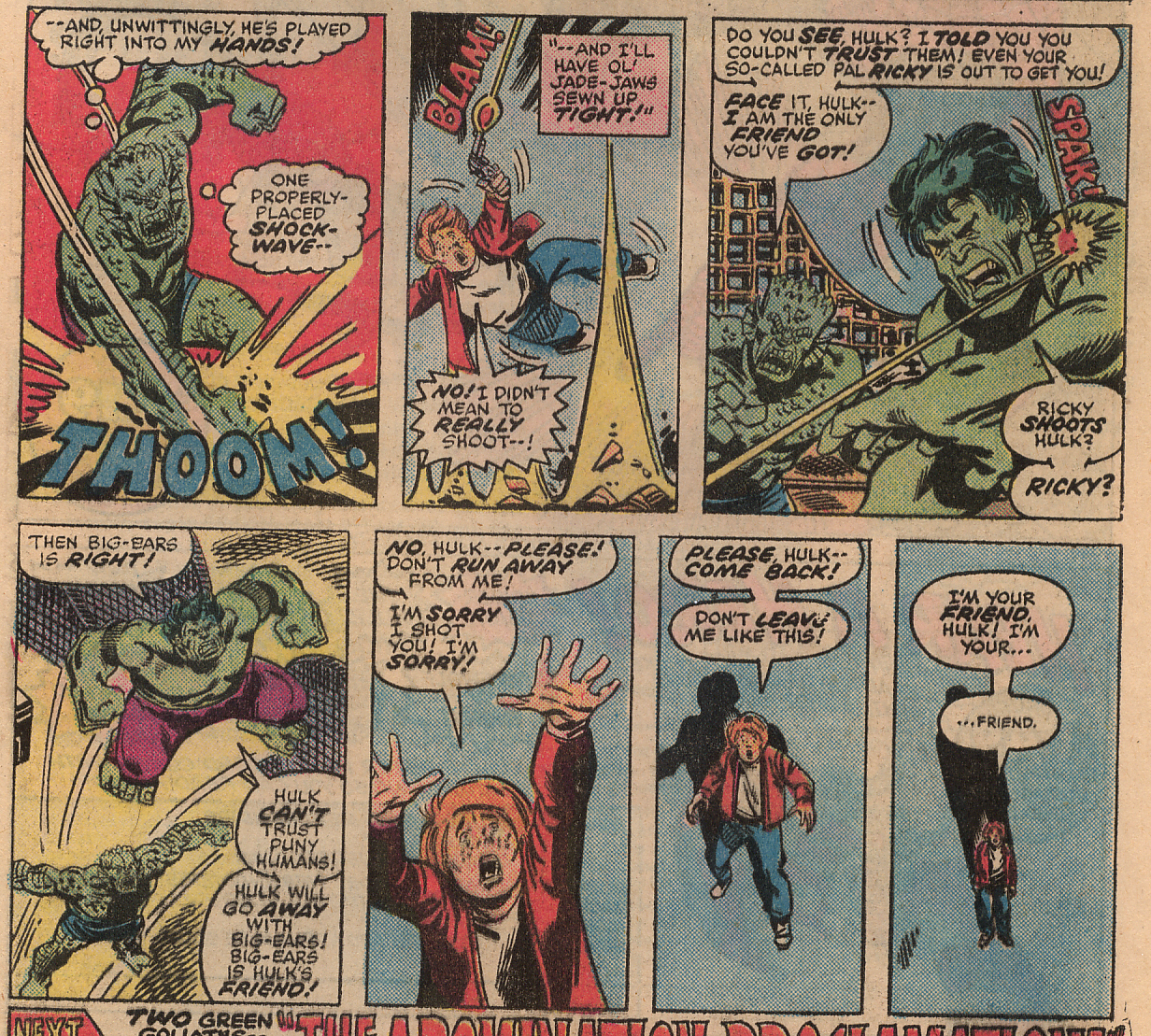
This sequence is from another Abomination issue, “Warfare in Wonderland.” In it, Hulk crosses paths with a young runaway named Ricky and thinks that at last he’s found a friend he can trust. And he has, except that asshat Abomination tricks him. My friend Tony Cruz, who lived two doors down from me, was the one who first showed me this comic, and I traded him a big rubber snake and a cap gun for it.


This panel takes me back to New Jersey, where we were visiting my Aunt Ann and Uncle Barry. My uncle listened patiently while I showed him just why the picture was so cool—the bad guy chained up the Hulk, see, but after the Hulk calmed down and turned back into Bruce Banner, he was small enough to climb out. I remember my uncle nodding and smiling, probably not following my breathless explanation or really caring, but definitely happy to spend time with his nephew and Godson. That’s how I like to remember my uncle—looking at a Hulk comic with me, instead of his slow, awful descent into Alzheimer’s.


This last sequence is from my favorite issue of all, “Triumph of the Toad.” It’s basically one long fight between Hulk and the Toad Men, led by their king, Torkon. Virtually every panel of this particular comic is etched in my memory; I remember reading and rereading it until it fell apart, replaced years and years later with a little help from a vendor at Comic-Con 2002. These four panels show the genius of Herb Trimpe’s visual storytelling with their varied yet fluid perspectives and angles, and they also embody the essence of the Hulk’s narrative—he’s chased, captured, abused in some way, and then escapes (usually into another crappy situation). I couldn’t get enough of this as a kid.

Or as an adult. Don’t get me wrong; I’ll definitely see Man of Steel, but it will be with the detachment that I bring to most of these comic book movies today. It’s a detachment based on the understanding that these versions of my comic book heroes are spectacles, lighter than the air under a bird or a plane, and not the stuff that childhoods are made of.


Saturday, April 13, 2013

Beaver Bites Man, or, An Eel in the Butt Is Worth Two in the...


            Like a lot of people, most of my exposure to news today comes from social media. Someone will tweet a headline or post a video on Facebook, and then I can kiss the next fifteen to sixty (or more) minutes goodbye as I delve into not just the original link but any and all things even slightly related to that topic.
This week, there were two stories that cost me productive morning hours. The first was a story about a Chinese man whose, ahem, “offbeat predilections” resulted in a20-inch eel burrowing into his large intestine. The writer of one story about this incident mentioned that eels like to burrow in “muddy places,” so the introduction of this creature to one’s anus is even less advisable than you might think, if that’s possible. (Fun fact, which I discovered at minute seventeen of my eel exploration: electric eels are not really eels. They’re knifefish).
            The second—and more interesting—story this week was about a beaver attack. Someone in my Facebook feed who enjoys wasting time even more than I do (you know who you are!) posted a video about a guy in Belarus who saw a beaver waddling its way down a road and thought, “Hey, what a great video opportunity.” It probably sounded different in Russian. Or Belarusian. Or whatever they speak in Belarus (note to self: Google this later). Anyway, things didn’t work out so well for him. The video is scary; what begins as a cute nature video becomes, in an instant, an outtake from The Blair Witch Project: the beaver charges, and the image goes blurry, then frantic, and finally static as the camera falls. Cut to black.
            It maybe goes without saying that after watching it several times, I headed straight to Youtube and searched “beaver attacks.” Turns out, there’s a lesson to be learned. Don’t get close to wild animals.
            But the real story is not my penchant to follow trivial and tangential paths through the Internet; in fact, I think I may have covered that in an earlier post. The real story is about truth.
            If this story is true, the man died, having bled out when the beaver severed his femoral artery. When I showed the video to a colleague—not with any particular purpose in mind—his immediate response was, “That’s fake.” I asked why, and his only reason was, “C’mon!” We happened to be with some of our creative writing students, so we turned the question to them. After watching the video, they were split. Some laughed, and some cringed. The ensuing debate—if you could call it that, which I wouldn’t—led to two important and paradoxical questions, especially if you’re someone who is working on the craft of writing.
Is everything believable today?
Is anything believable today?
            In his excellent book The Art of Fiction, author and teacher John Gardner calls the world the writer creates the “fictive dream.” A writer’s job, therefore, is to invite readers into that dream. It’s a backbreaking chore with not a whole lot of payoff, this business of creating worlds out of words. And I wonder if the job is made harder or easier by our internet culture—have we become more willing to believe the stories that abound out there, or have we become cynical that any of them are true?
            I’m not sure what the answer is to this question, even for myself. I know, intellectually, that there’s no such thing as Hogzilla or the Montauk Monster or the Derbyshire Fairy, but part of me wants to believe in them. Wouldn’t that be cool? Who doesn’t want to live in a world with chupacabras or with a horse-sized dog named Hercules? And sure, I believe in science, but I still want to charge my iPhone with an onion.
            Exactly where I range on the continuum between absolute gullibility and jaded cynicism varies, but I do know that whether I’m trying to write the fictive (or non-fictive) dream or getting lost in it as a reader, it helps if I want to believe in the world’s possibilities, even if some of those possibilities are downright scary, like beavers who attack or eagles who fly off with children.
            I’d love to keep going, but during one of the fifty-seven breaks I’ve taken while writing this, I checked Facebook and read another story that I need to follow up on (right after I find out what language they speak in Belarus). Seems that there’s a guy in Australia with a rare genetic condition. Every part of him has aged normally except for his head. Instead of jumping right to “Aha! Photoshop strikes again!” I find myself wondering what life is like for him. What does he go through each day? What trouble finds him because he has the head of a baby? Can’t there be some kind of truth in all of this?


            I’ll keep you posted.


Saturday, March 2, 2013

Books and Junk


In southeastern Arizona there’s a little town called Quartzsite. It wasn’t much more than a blip on my map, but it looked like the only spot of civilization for miles around. Pedaling onto the main drag, I saw a big banner that proclaimed, “Home of the WORLD FAMOUS MAIN EVENT,” and that’s it. I assumed that the seemingly endless rows of stands selling a colorful assortment of crap—signs, rocks, pottery, t-shirts—were said main event. I appreciated how obvious it all was. It was only my fifth day out, but that time had  stretched into one long lesson about how badly I could misjudge things--distances, the heat and wind, my energy, and most of all, how exposed I would feel alone on my bike.
            My destination for the night was Salome, which was still about thirty-five miles down the road. In Jack Kerouac’s On the Road, he mentions taking a bus from Blythe (where I’d slept behind a bait shop the night before) to Salome, and I tried to recall the line but couldn’t. As I headed out of Quartzsite, something happened that seemed to defy mere coincidence. I spotted a used bookstore that was open even though it was Sunday.
            The store, Reader’s Oasis, sat at the end of a long, gravel parking lot, and the building itself had a western-y feel to it. Wooden front porch and rail that, if it were one hundred years earlier, I might have used to hitch up my horse. As it was, I leaned my bike up against it. And as I did so, I glanced into the store and did a quick double-take.
            A naked man stood in the doorway.
            Well, almost naked. I was looking at him from behind. His body was rail-thin and resembled an old baseball glove left out in the sun too long. A cowboy hat sat atop long gray hair. Down below, the tiniest hint of string circled his waist and disappeared into his butt crack. He was talking to a guy wearing glasses, a collared shirt, and khakis, and I assumed that I was looking at some crazy customer talking to the store’s owner. I was more or less right.
            I could hear one of them speaking: “…I live a celibate lifestyle, but I still like to look at sex books. Do you have any sex books?”
It was the guy in khakis.
            “Well, I can show you what I have,” the naked man said, and the two walked to the back of the store.
            After a few minutes the naked man returned, smiling.
            “You look like you’re on quite a journey.”
            “Uh, yeah,” I answered, trying hard not to think about the little crocheted sack that was holding his junk. “San Diego to North Carolina.”
            “Isn’t that something?” he said. “Mind if I take a gander at your rig?”
            It took me a second to realize that he was talking about my bike.
            He inspected it closely, asking me questions about the ride, the panniers, what I packed, and how the trip had been so far. Somehow, as we talked, I completely forgot that I was talking with a naked man and we were not standing in a locker room.
            “I’ve got a Trek myself,” he said, pointing with his thumb to some vague spot behind him. “Once a year, the wife drives down to Yuma to do some shopping. I’ll bike down there and catch a ride back with her. Yuma’s nearly all downhill from here.”
            I felt a question forming on the edge of my mind, but then the celibate guy came back to the front of the store. In both hands was a stack of reading material that I assumed were sex books. If I didn’t already know better, I would have sworn he was some preppy grad student getting ready to write a research paper. The naked man left my side, and I took a look at the numerous flyers that hung outside the front door. One was bright yellow and read, PUBLIC NOTICE—STORE-OWNER WEARS ONLY A “THONG”…IN OTHER WORDS, NUDIST ON PREMISES.
            The naked man returned to talk to me, now his only customer. He told me his name was Paul Winer, and he’d been in Quartzsite for almost twenty years. In addition to being a nudist and running a used bookstore—a pretty good one, I’d decided after poking around—he was also a musician who used to perform under the name “Sweet Pie” and a cartoonist who still drew for the local papers.
            “I’m the second most Googled thing in Quartzsite,” he told me.
            “What’s first?” I asked, hoping that our understanding of the word “google” was the same.
            “The big gem show every year.”
            I was about to take off when I remembered the reason that I stopped in the first place.
            “Ah, Kerouac,” he said. “I haven’t seen a copy since last December.”
            As I maneuvered my bike back up the gravel to the main road, Paul shouted after me, “Keep your eyes open!”
            I pedaled back onto the highway and continued east, already shaping the encounter into an amusing little story to help me on the uphills I was surely heading toward. I was trying to figure out the ending—some way to work the sex book guy back into it—when the question that almost came to me earlier returned, fully formed. It was so sudden and so obvious that I actually shouted into the sandy, rock-strewn hills all around me.
“SHIT!”
            I should have asked him if he bikes to Yuma naked.


Saturday, February 2, 2013

Why Bike?


            “It’d be a lot faster by car.”
            I was eating a stack of pancakes at the Coyote Flats Café, a little place that—together with the gas station a quarter of mile down Highway 60—was the only sign of civilization I’d seen in this desert for the last few hours. The pancakes were perfect. All spongy in the middle and crisp on the edges. They were so good that I didn’t even mind the imitation syrup, no parts of which had originated in any tree of any kind.
            The place was empty except for an older couple a few booths away—regulars, I’d gathered, based on the way they tossed names back and forth with the waitress. The only other person there was a barrel-chested guy who’d been lingering by the pool table in back, an unfriendly-looking bulldog panting by his feet. The man stood and wandered behind the counter, where he refilled his coffee cup and squinted through the front window to where my bike was leaning in the shade. He asked me about it and stepped from behind the counter. That’s when I saw the big silver .45 strapped to his hip. Welcome to Arizona.
            I forced myself not to stare at the gun as I told him that I was biking across the country, that I had left San Diego about a week earlier and was hoping to get to the Atlantic by the end of next month. When he shrugged and offered his succinct advice, I didn’t contradict him.
            What I thought was, Well, yeah, it would be faster by car, douchebag. But speed isn’t really the point.

As I was biking through Monument Valley on Highway 163 less than a week later, a Honda Civic blew by me at about seventy miles per hour. A few minutes after that, coming the other direction, a rusty white pickup truck crossed the double yellow line to pass a slow-moving camper. There wasn’t much of a shoulder to speak of, and both of these vehicles came close enough to push me aside with a blast of hot wind. But I was annoyed less by almost being flattened than by their need to rush. We were in the midst of one of our country’s most picturesque places, the land where John Ford filmed some of the greatest westerns of all time. All around us, ancient fingers of red rock reached into the azure sky, dwarfing those of us just passing through this land of almost spiritual quietude. And then some bozo would roar by, jockeying around a car to get somewhere—where? where?—just a little bit sooner.
I was annoyed at the flash of recognition, too. I’ve been that driver, hurrying to pick up one of my sons at school, hurrying to a meeting, hurrying to a movie, or just hurrying because I was angry at that guy ahead of me who couldn’t seem to find his gas pedal with both feet and a map.
But life goes by fast enough without us shoving it along—an easy thing to do when we’re insulated. In our cars, with the windows up and the radio on, we’re separated from everything with sound and AC and metal and glass. A speedy little bubble on our way from here to there. On a bike, though, there’s no bubble, no real speed. And slowing down does wonders for your perspective. It’s hard to miss things. Even when I was headed downhill or cruising along with a tailwind, I could still see every empty coffee cup and broken bungee cord on the ground. I could get nice long looks at a field of corn or dark rain clouds. I could stop and talk to a woman hanging garage sale signs—like I did in Blythe, California—or ask a farmer about how the tobacco crop was looking this season—like I did in White House, Tennessee.
Of course, life on two wheels is what you make of it. One afternoon, as I was working my way to Dodge City, a motorcycle pulled off to the shoulder up ahead of me. The rider dismounted, stood in back of his cycle, and gave a little wave. When I stopped, I could see that he was smiling.
            “Need any water?” he asked.
            “I’m good,” I said. “How’s it going?”
            He grabbed my hands and gave it a few vigorous pumps. “I’m Ron,” he told me. “Thirty years ago I did the same thing you’re doing.”
            He was twenty when he set out from Boulder to New Hampshire on his bicycle. Now fifty, he was retracing his route. He still had his original map, which we somehow managed to look at in the blistering Kansas wind.
            He told me that he’d turned twenty-one on that ride. On his birthday, he was in upstate New York, deep in wine country. He wandered into a winery, bought a bottle, and drank it by himself outside of his tent that night.
            “I’ll always remember that,” he said.
            We talked for a few more minutes, took each other’s picture, and then parted ways, but not before he gave me a hug and told me to travel safe.
            I took my time before starting again. Standing next to Rusty, I leaned into a stiff prairie gust—the kind that had been pummeling me all day—and watched Ron’s motorcycle grow smaller in the distance. I turned to remount, and as I did, I noticed two spots of color on the other side of the road. Bikers, both bent low over their handlebars, legs churning furiously. The headwind that had been slapping me in the face gave them a powerful shove from behind.
            When they were nearly opposite me, I smiled and raised my arm in a big wave. I hadn’t seen another biker in days.
            There was no way they didn’t see me, but they sped on by without so much as a nod.
            I’d like to report that they were racers sporting skintight spandex, ultralight bikes, and teardrop-shaped helmets. People out for weekend exercise, focused on the task at hand to the extent that a stop-and-chat was out of the question. But they were just like me. Front and rear panniers filled to bulging. More gear wrapped tight on top of the rear rack. At least three water bottles visible on each bike. Out on the road for a while, no doubt about it. Eyes straight ahead, locked on course, no time to share a few minutes with a fellow traveler.
            What’s the hurry, guys?

Friday, January 4, 2013

Yet Another FAQ (Plus a Few Words about Revision)


            I tell my students that writing is all about revision. All writers’ drafts are crap at the outset, and it’s only through careful, astute revision that strong writing emerges. But what is revision? One thing it’s not is proofreading; correcting spelling and grammar mistakes, changing a word here and there, maybe adding a sentence are all final steps in the writing process, and jumping directly there from drafting is to leave out the part that involves the real work. That work—revision—is like radical surgery, the kind involving amputations, resections, grafts, and reconstructions. And when you’re performing such procedures on something you love…well, it can be difficult.
Difficult but necessary. And the best way to approach the task is without emotion. Yes, you may have worked hard to write that particular scene, but that doesn’t change the fact that it might not help the story and therefore needs to go. The same might apply to a character you happen to like. Or the narrative point of view. Every great novel has its phantom limbs, which are felt most keenly by the person who did the messy business of removal—the author. My own approach to revision is best summed up by a line from my favorite movie: “it’s not personal…it’s strictly business” (if I have to name the movie, then I don’t even know what to say to you), and I’ve been repeating this line to myself ad nauseum over my winter break, which I’ve spent cutting and slashing material from my book, trying to get it down to a reasonable fighting weight of about 100,000 words. It’s slow going, but not because of the emotion; revision is hard work even without that.
So with all this said, I’m presenting another installment of my “Frequently Asked Questions.” One caveat, though. These short pieces might not be the “sneak previews” as originally billed; they may very well end up being deleted scenes.
Without further delay, here is today’s question:

“What Did You Eat?”
            Lots and lots of crap.
When I told people that I was going to bike cross country, alone, they pictured vast expanses of nothingness where I’d have to dig for water and forage for meals. I have to admit that I’d pictured a little of this myself. Chopping wood for a fire, clambering down rocks to get water from a reservoir, cooking up a nutritious gruel made with whatever roots and berries I could scavenge.
But I never cooked a thing while on tour.
The vast majority of my food came from gas stations or grocery stores with names like “Piggly Wiggly,” “Ingels,” “Loaf ‘n’ Jug,” “Shnucks,” and “Harris Teeter” (I thought that this last one, when I first saw it, was an upscale furniture store).
Also, I didn’t carry a lot of food with me.
In the morning I would eat and drink leftovers from the night before. A bottle of Vitamin Water, a banana, maybe half a bagel. Throughout the day at various stops, I would load up on the same and indulge every now and then.
I went through a Milky Way phase in Kansas and switched to Three Musketeers in Tennessee. About 90% of my gas station stops resulted in the purchase of a cherry pie. The Hostess version had better icing, but the Little Debbie ones were cheaper and came in a box that kept them from being crushed in my overstuffed handlebar bag.
In Arizona I discovered the single greatest beverage in the history of beverages: The Vanilla Rockin’ Refuel from Shamrock Farms. Sweet nectar from the heavens. In addition to taste, it had everything I could hope for in a road drink: calcium, vitamins, fat, sugar, and a shitload of calories.
And then there were Clif Bars. I always had one or two of these tucked away somewhere on my bike. Unlike so many other protein or meal replacement bars, Clif Bars don’t pretend to be candy bars, so there’s no chocolaty coating to degrade into a gooey mess after sitting in my handlebar bag for more than twenty seconds. I ate so many Clif Bars that I can no longer eat Clif Bars. Just typing the name makes me a little queasy.
I didn’t carry food, but I met a few bikers who did. One was a young guy heading from Orlando to San Francisco. Stashed in various places on his bike were two family-size cans of vegetarian baked beans, cups of instant mac ‘n’ cheese, cans of soup, a couple of boxes of rice and beans, a loaf of bread, and a huge jar of peanut butter. On top of this, he had a small cookset and stove. He was obsessed with caloric intake and kept to a schedule where he ate five meals a day, making sure that each one packed at least two thousand calories.
I met another biker who always had a bag of bagels with him. We bunked together one night, and I watched him work his way through half of it. He washed it down with a half gallon of orange juice. "Eating for tomorrow," he said, juice running down his face.
Food was sustenance, and I’d shovel it in like coal to a raging furnace. But once in a while it seemed to be something more. A bag of pretzels from a guy named Pete at a gas station just over the Kansas-Missouri border. A peanut butter and jelly sandwich from a mom at a scenic overlook in Tennessee. A bottle of water from a guy named Sam at another gas station, this one in North Carolina. Whenever strangers stopped what they were doing and gave me something to drink or eat, I’d feel a little less alone.
I met Alan in the Ozarks. He was in his late fifties, worked for the forest service in New Zealand, and was on his way from Astoria, Oregon to Yorktown, Virginia. Our paths crossed for two nights running. On the first night, I learned about how his wife had died of cancer, how he’d felt lost after that, and how he found his way back on his bike. On the second night, I dragged him through rain-soaked streets to a $4.99 all-you-can-eat pizza buffet. I was in the mood for some serious eating, and it turned out that Alan was, too. We very nearly cleaned them out. Between the nine different kinds of pizza, the pasta (with a choice of marinara or alfredo), a loaded salad bar, and stacks of crunchy-on-the-outside-chewy-on-the-inside brownies, we racked up over a dozen plates of food. By the time we were done, our table looked like the wreckage from a little league team after its end-of-season party. We shared some of the stories from the road and our lives in that brightly lit booth, and in the morning we would part ways, Alan heading north to St. Louis and me due west to Chester, Illinois. We never saw each other again—I knew we wouldn’t—but when I remember our brief friendship, I can still see those steaming platters of pepperoni pizza, the heaps of salad and toppings, those plates overflowing with sugar-dusted brownies.

Sunday, December 2, 2012

Stuff I Saw

As I continue to work on the final revisions to That Hidden Road, I'm also thinking about how I'm going to assemble the different narrative pieces. Most of the book consists of long chapters that "cross cut" between my experiences on the road and various memories, but there are also shorter chapters that will pop up from time to time, like the "FAQ" writings that I've posted here.

And then there are the comics. My plan is to sprinkle throughout the book several different comics--a couple of multi-page stories as well as some one-pagers. One group of these one-pagers is a short series called "Stuff I Saw," which I intend to appear a little rough, as if from a sketchbook. I did all of the layout, lettering, and art myself. Most of the images are based on pictures I took, and observant readers may notice two of them that already appear on this blog. Anyway, here's a preview of four of the "Stuff I Saw" comics:

A little gruesome, maybe, but I had to pay some kind of tribute to all of the dead animals that I saw. By the way, coming across roadkill while biking is about a hundred times worse than while driving. First of all, there's the smell. Second, there's the fact that I was moving slowly, so I had plenty of time to take a good, long look. Third, there's not much you can do to avoid it. I tried to move around a dead possum in Missouri and almost got hit by a pickup truck.

I love roadside kitsch, and to my mind, there's none better than big statues of fake people. My two favorites are on the bottom row, both found in the tiny Illinois town of Metropolis. The best part was that "Big John" is about ten feet taller than Superman.

Comics are good at amplifying the quiet moments of life, and I tried to keep that in mind when I sketched these landscapes from various parts of the trip. I'm the least happy with the "Tennessee" panel; all of that dark stuff is supposed to be kudzu, which grows crazy-fast and has taken over thousands and thousands of acreage in the South.
Not every dog was my enemy. I made some canine friends along the way, too, and I wanted to get them into the book in a unique way. 

I'm planning to post more of the comics if there's any reader interest, so let me know!