Showing posts with label comics. Show all posts

Saturday, August 15, 2015

My Hero, Teddy N.

A few months ago, Shannon and I were watching an episode of The Mindy Project (shut up—it’s good!), and there was a scene where one of the characters was sitting in his boyhood room at his mom’s house. Just over his left shoulder, in the background, I saw a green blob.
            “Oh my God,” I said, scrambling for the remote. “Is that what I think it is?”
            “Wuzzat?” Shannon said, waking up.
            I paused the DVR, backed it up a hair, hit PLAY, paused again—and then repeated this process four or five times until I was able to freeze the half-second that the green blob was onscreen. It looked something like this:


By now, Shannon was fully awake.
            “What the hell are you doing?”
            “Nothing. Oh my God. Go back to sleep. Holy shit. Do you know what that is?”
            “What what is?”
            I got up and pointed to the green blob on the screen. “I think it’s one of those wax alligators.”
            Sadly, I lack the words to describe the look on her face.
            For the record, this is what I saw through the blur:


For many people who grew up in the Chicagoland area, there should be a flash of recognition. Especially if they, like me, were treated to any family or school field trips to the nearby Brookfield Zoo. I loved the real animals, of course, but what I looked forward to most were the wax ones. Stationed at the entrances and exits of the various animal houses were Mold-a-Rama machines—bubble-topped contraptions about the size of a hefty jukebox, where, for fifty cents, you could partake in injection-mold magic. After receiving your quarters, the machine rumbled into action. Two long pistons—each holding half of a metal block (the mold) with hoses sprouting off the top—pushed slowly together. Hums and clicks and hisses sounded as fluids and air were pumped into and out of that mold. A light on top of the machine changed colors to signal the different stages of manufacture. Then, a little over a minute later, the mold halves separated, and there stood the red giraffe or black panther or green alligator. A little blade on a long, thin arm would slide from the back of the machine and knock the animal off the sloped metal surface, sending it tumbling into the chute at the front of the machine. You then opened the little door in front, scooped it out, and—holding it by the base—waved it gently for a minute or so until it cooled completely. I learned this last step the hard way when I grabbed a rhino with too much enthusiasm and put my thumb through his chest.
            You can watch the process HERE, but it’s missing two key features of the experience: the smell of melting crayons, and the sheer joy of retrieving your prize.
            I write this description in the past tense, but that’s not completely accurate. We live in a wonderful time where the collected wisdom and knowledge of the ages exist—quite literally—at our fingertips, so for the twenty minutes following my alligator sighting, I kept Mindy on pause while I Googled away and discovered several things, but for the sake of brevity I’ll stick to the highlights:

  1. Mold-a-Rama machines are still around
  2. They now cost $2
  3. The animals aren’t wax; they’re plastic
  4. I’m not the only one obsessed with this stuff

           In fact, if you type “moldarama animals” into Google Images, you get a pretty good look at the animals that come out of the machines and those machines themselves. Really, you should do that right now. I’ll wait.


            Pretty cool, right? Just in case you impatiently charged ahead in this post, here’s some of what you missed:


            What the images don’t tell is the larger story, which also exists on the internet HERE, HERE, and HERE (to list just a few).  And because it’s very likely that you’re one of those readers who won’t pause to Google mid-read, I’ll summarize.
            Mold-a-Rama was founded in the early 1960s in Chicago (and debuted at the 1964 World’s Fair), and today it’s owned by a family business that’s run out of a house in Brookfield, Illinois. The owner—Bill Jones—and his two sons—Bill Jr. and Paul—are charged with maintaining these machines, the most-recently built of which dates back to 1964. It’s their dedication that keeps this little piece of the past alive.
            After I delivered this last news to Shannon, she paused before she spoke.
            “Can we please watch the rest of the show now?”

            My obsession might have ended there, but a couple of weeks later I happened to be visiting Chicago and I found myself killing time in the suburb of Downers Grove, where I grew up. I wandered into the library and was greeted by the sight of glass display cases where local kids had put their collections on display. There was a toy car collection, a Pez dispenser collection, a doll collection, and then this one, belonging to a “Teddy N”:


I don’t have any Mold-a-Rama animals any more, but even at its height, my collection would have paled in comparison to his. In mine, animals were always in some state of injury—the panther's tail missing, the gorilla’s hand snapped off, the elephant’s base cracked. And it wasn’t nearly as comprehensive; I’m embarrassed to say that I had no vehicles and not even a single dinosaur (somehow, I was in my twenties before I ever visited the Field Museum). And I certainly didn’t have (but would have fiercely coveted) this boss Komodo Dragon:
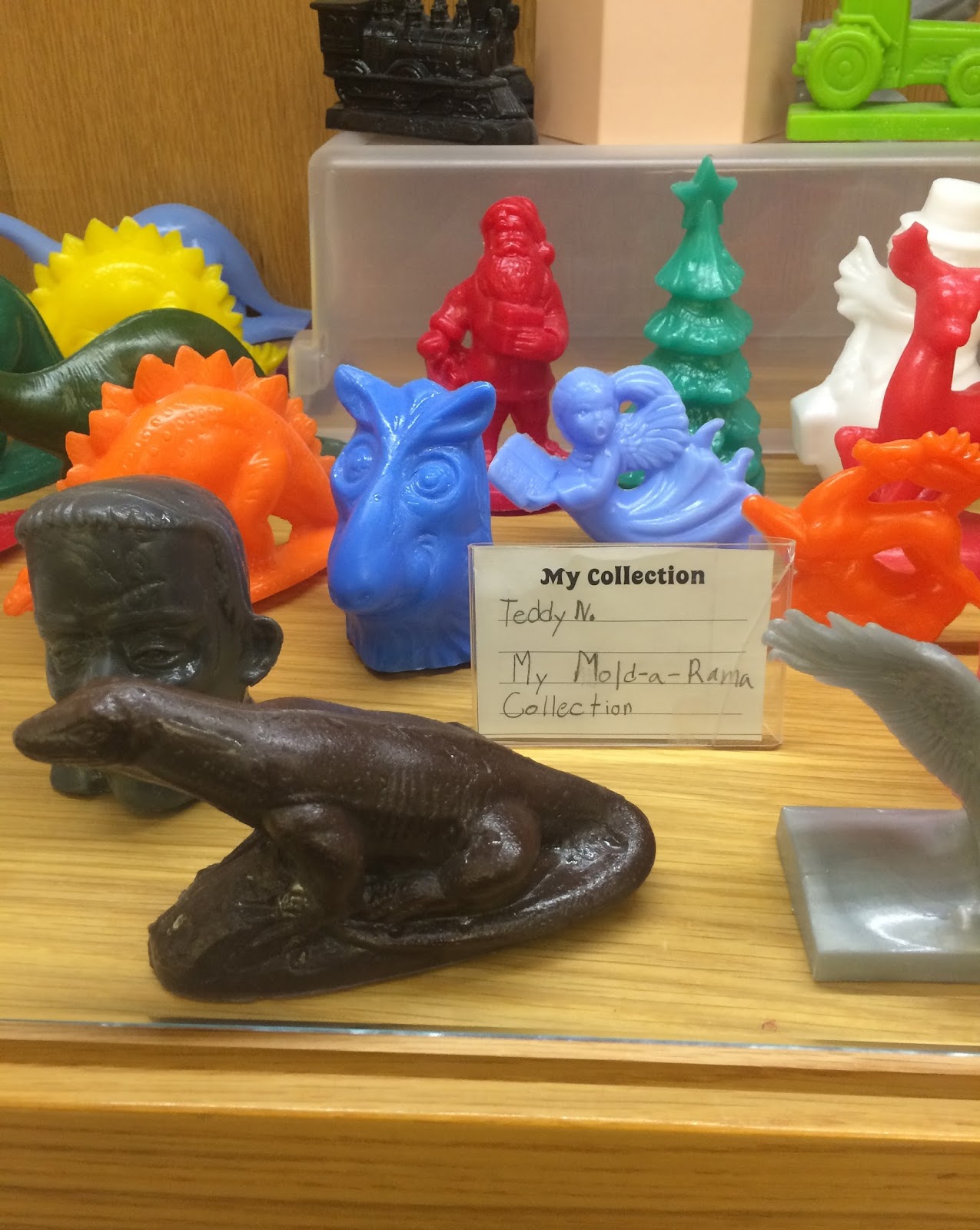

I don’t know anything about Teddy N. other than his name (though, based on his writing, I can ballpark his age), but I have a feeling that we would be great friends, he and I.
            Needless to say, I immediately texted pictures of Teddy N.’s collection to Shannon with the words “SEE?!!” I felt vindicated.
            Alas, the feeling was short-lived. She texted back a blunt, withering question: “Why can’t you be interested in normal things?”
            She’s referring, of course, to my obsession with “junk” (her word, not mine) from the past—comic books, record albums, sports cards, monster/superhero models. In what has become an ongoing haranguing conversation, she suggests that I just get rid of the stuff.
             At these moments, I could use a friend like Teddy N. But I have to do without him and explain that these things aren’t junk; they’re valuable artifacts of the past. My past. Because, really, so much of my past—like anyone’s—is either going or already gone. Those collections are a way to hold on to something. That’s why I’ve bought back issues of some of the comics I had as a kid (but that my mom threw out)—especially old issues of The Incredible Hulk, and why I’ve bought and builtmodels I had as a kid, and why Shannon has caught me more than once spending the better part of an afternoon watching 1970s TV themes on Youtube.
            I don’t imagine that Teddy N. is reading this, but if he is, I hope that he listens to what I have to tell him. Keep that collection safe. As you grow up, move it from place to place with you, and don’t ever rent an apartment or buy a house without making sure that there’s room for it somewhere. If it’s important enough to you now to let the good folks at the Downers Grove Public Library put it on display, then it’s going to be important to you later on. Trust me on this.
            But something tells me that Teddy N. is the kind of kid that knows this already.


Thursday, July 16, 2015

Putting the Comics into Comic-Con


            Unless you’re one of the 130,000 or so people who annually attend it, San Diego’s Comic-Con has probably been packaged to you in the media (assuming that you’re even interested in such things) as a four-day bacchanal of superhero movies, television shows, and cosplayers.
            And to some extent, it is. I’ve been going to Comic-Con for the last eighteen years (a number dwarfed by many Con-goers, I assure you), and in that time I’ve seen the attendance triple and the convention center undergo a major expansion—none of which was due to a growing interest in comics, per se. It’s been due to the increasing number of movie and television stars, studios, and fans in attendance. Two of the biggest draws this year were for movies that won’t open until 2016 (and if you’re waiting for a plug for them, then this probably isn’t the blog post for you).
            While outsiders get a pretty one-dimensional view of Comic-Con, the truth is that the convention is many things to many people (if you’re interested in the range of the “Comic-Con experience”—and the Con’s shift in focus over the years—then you should check out Morgan Spurlock’s 2011 documentary, Comic-Con Episode IV: A Fan’s Hope). To me, Comic-Con is about the comics, though I'll admit that I appreciate a good star-sighting and take copious pictures of the cosplayers. Many people—including insiders—have been sounding the death knell for comics at the Con, but I still saw plenty to command interest. So here’s a rundown of some titles that more people should be reading—titles that scored either awards or panels (or both) at this year’s Comic-Con:

Let’s get the biggies—DC and Marvel—out of the way. First up is Green Arrow. Or, more accurately, Green Arrow #41, which starts a (hopefully long) run by one of my favorite writers, Benjamin Percy.  Known primarily as a novelist (Red Moon, The Deadlands), Percy is bringing his unique sensibility (read: sophisticated horror) to one of DC’s canonical titles. Only two issues into his run, Percy and artist Patrick Zircher have already established a dark, chilling tone to the world of Oliver Queen.
On the Marvel side, I recommend one of the most exciting books out right now, Ms. Marvel. In this iteration, the titular hero’s secret identity is Kamala Khan, a Pakistani-American teenager living in New Jersey (and who happens to be the first Muslim character to command her own title). Writer G. Willow Wilson and (usual) artist Adrian Alphona have created a smart and engaging character here, and they’re using the title to explore not only the complexities of being a teenager, but also the complexities of identity in all its forms, including religious. Two quick asides. First, images of Ms. Marvel were used to protestanti-Muslim ads on San Francisco buses. Second, this cutie:
She was the darling of a couple of panels I attended at Comic-Con, including the packed house at “The Women of Marvel.”

While we’re on the subject of women in comics, there’s Image Comics’ Bitch Planet. Written by Kelly SueDeConnick and drawn by Valentine DeLandro, this comic is an in-your-face feminist reclamation of the “women in prison” genre, and it gets better with each issue. As an added bonus, DeConnick and DeLandro have a lot of fun with the ads and columns at the end of each book. Definitely a title to watch.

Also from Image—which has firmly established itself as the most interesting of the mainstream publishers—is Saga, from writer Brian K. Vaughan and artist Fiona Staples. I’m not a huge sci-fi/fantasy guy, but this story of on-the-run star-crossed lovers from warring planets (as narrated by their baby) succeeds at hooking both the gut and the brain. I’m sure that somewhere there are adaptation talks going on, and I’m sure that the result will be yet another example of awful CGI bombast. Saga has also won the Eisner for “Best Ongoing Series” three years running.

From Fantagraphics this year is the two-volume edition of Dan Clowes’s Eightball. While the book carries a hefty price tag, it’s worth every penny (if you can afford it). These hardbacks come packaged in a slipcase, and they reprint issues one through eighteen of the legendary comic—which, not incidentally, was one of the titles I discovered in graduate school that hooked me on the amazing possibilities of the medium. Clowes is a true master of comics, and this collection of his early work is not to be missed. Also check out David Boring, Ice Haven, and The Death-Ray, which appeared in the pages of Eightball but are not (as Clowes points out in his introductory notes) included in this set.

These last two (okay, three) graphic novels are ones that I haven’t yet read but plan to shortly. The first is Mariko and Jillian Tamaki’s This One Summer, a coming-of-age storythat has received both critical acclaim and some undeserved notoriety. I had heard about its excellence before Comic-Con, but it wasn’t until I attended a panel on banned comics put on by the Comic Book Legal Defense Fund (CBDLF) did I find out that This One Summer has been the target of censorship.


On Saturday morning I attended one of the most stirring panels I’ve ever seen at Comic-Con. The focus was TopShelf’s March trilogy, written by Congressman John Lewis and Andrew Aydin and illustrated by Nate Powell. The books (volumes one and two are currently available; book three comes out next year) cover the life of Lewis and his struggles for civil and human rights. At the panel, Lewis spoke passionately about the importance of nonviolent revolution as a way to combat our society’s inequalities and injustices—a lesson he learned directly from Martin Luther King, Jr. As he spoke of his hope for the younger generation to carry this message forward, I couldn’t help but think of my two sons, both of whom are much more engaged in the issues of the day than I was at their age. At the conclusion of the panel (which was packed), Congressman Lewis asked everyone to walk with him down to the exhibition hall floor, where he and Aydin and Powell signed copies of their book. Here are a few shots:


            The last thing I want to mention is that many see Comic-Con as a haven for fanboys and fangirls, but there’s actually a thriving academic presence there as well. Aside from the many sessions aimed at (and created by) teachers and librarians, the Comic Arts Conference has been integrated with the programming at Comic-Con for over twenty years and is a place where comics scholars share their work 
with other academics and fans alike. One frequent presenter at the Comic Arts Conference (and friend of mine) is Dr. Charles Hatfield, author of Hand of Fire and professor at California State University, Northridge (CSUN). At Sunday morning’s annual “Tribute to Jack Kirby” panel, Charles announced that he’ll be curating “Comic Book Apocalypse: The Graphic World of Jack Kirby,” anexhibit of 100 original pieces by Jack Kirby that will appear at the CSUN artgallery from August 24th to October 10th. If you’re anywhere in the Los Angeles area, you should check it out.

            So that’s it from this year’s Comic-Con. The city of San Diego recently completed a deal to keep the convention at least through 2018 (at the likely expense of the Chargers, no less). I don’t know what the future holds, but if the comics rewards are as rich as they were this year, I’ll continue to set aside whatever five summer days this particular circus comes to town.


Saturday, December 21, 2013

Voices from the Road

I'm working on a longer, more text-heavy post (teaser: it might have the words "bucket list" in the title), but in the meantime, I wanted to share some of the comics from my recently-completed book, That Hidden Road. The images below represent a sampling, and they are sprinkled throughout the manuscript. I decided to draw and write these comics because, when I bicycled across the country, I had a lot of encounters with people that stuck with me, but they didn't seem substantive enough to warrant space in the narrative proper. These comics seemed like a good solution, especially because I've always thought that the medium excels at amplifying quiet moments.

Here they are:


To any publishers and/or agents out there, the book is finished and clocks in at 100,000 words. And if the fact that I have cancer makes you interested out of pity, I'm totally okay with that...


Sunday, September 1, 2013

The Evolution of a Page

Time has really gotten away from me. I can’t believe that my last entry was way back in June. Between now and then I’ve been to Chicago twice, taken a trip up the California coast to look at colleges with my high school senior son, and waded through armies of costumed fans at Comic-Con.

Oh, and I finished my book.

To recap, the book is called That Hidden Road, and it’s about my solo cross-country bicycle ride, which I made in the summer of 2010. It’s also about those parts of my life that made me think I needed to go on a long, long ride by myself.

I knew from the start that I wanted comics in the book, and I knew that I wanted to draw them myself. Problem was, my drawing skills were a little rusty and I’ve never made comics before.

As I drafted and revised the manuscript, I played around with some ideas for comics and eventually came up with three main types. Backin early December, I posted a few pages from one of these, which I called the “StuffI Saw” pages. Pretty simple idea—one page of six panels each in a more or less “realistic,” sketchbook-y style. The second group of comics I called the “Voices from the Road” pages. These would also be single-page comics, but have only four panels. The style would be a little more cartoonlike and focus on some people I met along the way who made brief but memorable impressions on me. I finished these over the summer. Finally, the third group of comics would be more sustained narrative; there’s a brief two-page story in the prologue called “Pre-Ride Jitters,” and there’s a longer (eight pages) story in the middle of the book called “Welcome to Springview Farm.”

This story covers the few days that I spent on a farm in Missouri—a farm that belongs to Jan and Bill Montgomery, who happen to be the mom and stepdad of my best friend. I didn’t want to fold that story into one of the other chapters; instead, I wanted it to stand on its own even though I couldn’t—at least early on in the writing—say why.

Now, with the benefit of hindsight, I decided to write a blog post that went into some detail about how part of this story came together, and I thought that the easiest way to do that would be to document the evolution of a single page from “Welcome to Springview Farm.” The page in question is the third of the story, and it covers part of the tour that Jan gave me of the farm and house.

In writing this and assembling the materials I used, I found it very helpful to me as a writer to step back and examine my creative process a little more closely. As I said before, despite my lifelong love of comics and the fact that I teach and write about them, I’ve never—until this book—tried to make comics myself, at least not in any organized way. So I thought I’d give a shout-out to several helpful sources along the way, including Scott McCloud’s Making Comics, Barrington Barber’s How to Draw Everything, Bruce Blitz’s The Big Book of Cartooning, the many Facebook postings by Ed Piskor of his work on Hip Hop Family Tree, several Youtube videos by Alison Bechdel about the construction of Fun Home, my friend and comics goddess Mary Fleener, and conversations with students much more talented than I am in this regard.

It’s hard to pinpoint exactly how the story came into being. I think I got the idea within the first hour or two I spent with Jan and Bill. They're incredible people who are also pretty wacky, and as Jan showed me around and told me stories, I realized that the written word alone couldn’t do justice to this bizarre and comic experience. I was going to have to tell the story through comics.

Coming to this realization was the easy part. In writing this book, I’ve found that the most challenging part of memoir comes in trying to shape and narrativize your experience. Fact is, there’s a lot of dead time in our lives, but story demands at least some kind of structure. To get there, we need to arrange, amplify, and discard the pieces of our experience and hope to hell that in doing so we arrive at a meaningful truth. With comics, one’s experience becomes even more fragmented—literally, by individual panels. Plus, the canvas is much smaller, and the words that make it in must be pared down yet still work effectively in conjunction with the corresponding image.

Because I’m a textual kind of guy, I started with a script, though that’s a little generous of a description. It was really more of a sketch with words—lines of dialogue loosely coupled with some ideas for images. The draft was long and rambling, and like most drafts, I ended up axing close to half of it. The section of the script that covers this particular page reads as follows:

Springview Farm is filled with strange and wonderful creatures…

Underfoot, the invisible barn cat
Goosey and Goofy (two llamas)
??? (pygmy goat)
A Watusi bull (image of me taking its picture while it’s trying to mount cow)

      Jan:  “Oh for the love of Mike, don’t show them that.”
      Me:  “Why not?  It’s nature!”
Jan:  “It’s Eskimo!”
Me:  “Huh?”
Jan.  “I don’t like the word ‘nasty,’ so I say ‘Eskimo’ instead.”

Inside the house is just as interesting…

Fisherman lightswitch
Stuffed owl that watched me.
Jan’s closets
      The Fairy Closet
      The Shower Closet
      The Memories Closet
            Closeup of Chuck and Dewey poster
Jan’s dolls

The events depicted on this particular page took place in late June of 2010, and I didn’t really start drafting this script until almost a year later (fortunately, I had my photographs and journal from the trip). Like most of the drafting I do, I didn’t pause too much to double-check details. For example, I couldn’t remember the name of Jan’s pygmy goat, so I let that go. I also didn’t know what kind of bull they had (just that it looked really strange), so I let that go and filled in “Watusi” later, after calling Jan. At that point, I knew that the goat wasn’t going to make it on the page, so I didn’t bother to find out its name (sorry, pal). As I wrote, I also knew that part of my brain was thinking in terms of comics. I had an idea about what to do with that bull, and I see in the writing that I had an idea for both the image and the word balloons.

The next step was to sketch the panel breakdowns. I  saw that there was way too much material here to fit coherently, so I had to narrow it down, to start shaping the experience into narrative. I wanted to make this part of the story unfold as a kind of a “walking tour,” but the big question was, What to keep? Two parts of this section jumped out at me: the Watusi bull and the dolls. For the moment, I put the dolls aside. I knew that I wanted the panel with the bull to be big—the width of the page. In part, that was out of necessity; there was too much image and dialogue to cram into a smaller panel. I figured the rest of the page would break down in a steady rhythm of three equal-sized panels per row. I laid out the panels as textboxes in Word, and they came out like this:


To accommodate this layout, I had to start this page with the bull scene, so I moved the the material in the script that comes before—the cat and the llamas—onto the previous page. That seemed to work well in terms of rhythm, where my introduction to the various animals would climax with the bull, and he’d be at the top his own page in a panel befitting his size and, uh, horniness.

Now, back to those dolls. Sifting through photos, journal entries, and memories, I recognized that the real “punch” of my tour of the farm was Jan’s collection of creepy dolls. Anyone who knows me well knows that I’m terrified of dolls; it all dates back to an episode of Night Gallery that you can read about here.

Because I wanted the “weight” of the page to come down on these dolls, I reserved the bottom row for them. With three panels left in the middle, I had to pick and choose from the remaining details. I knew I needed one of Jan’s closets in there (she has an interesting array of closets in the house), and I went with the converted shower closet, because it’s just so Jan. I also liked the light switch cover where the switch became the naked fisherman’s penis (again, very Jan). It seemed like it would be an interesting visual to pull off, so to speak. I also liked that it comes right after the bull trying to hump the cow. For the third image, I decided on the owl. I originally picked it because my plan was to make it the third image in the row so that two figures—a naked man and a bird—would “frame” the closet. Only later did I come up with a better use and reason for that owl. I did a very rough sketch of how I saw the panels:


The drawings are intentionally primitive; my purpose here was simply to get a very rough sense of what’s going to be on the page.

Now I had to decide on text and put the words into boxes and balloons. By visualizing the “containers” for the text, I’d get a better sense of how much space I had to work with and how to compose the panels. By sharpening the text into the exact language, I’d get a better sense of what exactly to draw. At this stage, I started to think more about that owl and what I was trying to do with the story as a whole. I said earlier that I didn’t want to fold my time at Springview Farm into a prose chapter and I wasn’t sure why. In actively mapping out the story, though, it came to me that it was about finding a substitute family on the road. In fact, “Welcome to Springview Farm” is split into two parts, and they bookend the very central chapter of That Hidden Road, when I drive to Chicago to see my real family. Thus, “Springview Farm” serves as a kind of counterpoint to that experience.

Anyway, back to that owl. The very end of the story is the day I leave the farm. It was raining when I left, and I wound up spending that night in a tiny Missouri town named Houston. I called Jan and Bill to let them know I made it to my next stop in one piece, and Jan confessed to me that they followed me for a few miles in their truck, just to make sure I was okay. As I was writing this part of the script, I wanted to convey that feeling of being watched over, and I remembered the owl, stuffed and staring at me in my room at the farm. Now, the thing about Jan is that she names everything, but I couldn’t remember if the owl had a name. Indulging a little bit in the “creative” part of “creative nonfiction,” I decided to name it “Mama Owl” and attribute it to Jan. I mention Mama Owl again on the last page of the story. At this point, I knew that I had to move Mama Owl to the middle of the page, which is the most important space in a comic. The panel breakdown with text inserted looked like this:


It’s worth noting here that once I typed the text on the page, more revision was needed. I had to shorten some lines, move some of the dialogue around, and play around with font sizes. The point here—and one that I stress to my writing students—is that revision is ongoing and the writing process is recursive; you take two steps forward and one step back almost constantly.

Once I was happy with the page, I printed it up, taped it to my drawing board with artist’s tape and the help of my t-square, boxed and ballooned all the text, and got ready to sketch my pencils. To help with this, I had two main tools at my disposal. First were the many, many photos I took at the farm. Here are some of the ones I used:


The second tool was my sketchbook. I’ve found that it’s been indispensible in testing out different visual ideas and to practice drawing different things. Here are a few of the sketches I made while penciling this particular page:


In the original sketch, I had Bill standing there, too, but the panel was getting a little crowded. Plus, the dialogue focused more on a back-and-forth between me and Jan, so I cut Bill out. But not to worry; Bill is very present in the rest of the story. And he knows I love him.

The next stage was actually biting the bullet and getting the pencils in the panels. I decided that I wanted to have some fun with the style, so I made the top panel more cartoony and the bottom six panels more realistic. I wanted to give those six panels more of a documentary feel to them—like a camera’s eye roving around the farm—so it made a certain sense to me that the art should reflect that. After the better part of a day filled with plenty of erasures, here’s what the page looked like with the text, boxes & balloons, and pencils:


The final stage was the inking. This is where pencil lines get sharpened and more depth is added through line weight and shading. I’m not yet completely confident with this very difficult skill, so I turned over inking duties to my talented buddy John. He threw my pencils on his lightbox, inked it up (without the text), and scanned it for me. I then opened it in Photoshop, retyped the text (and, yes, revised it some more), and performed some minor tweaks to the images. Here, then, is the final product:


All told, there are over thirty pages of comics in the manuscript of That Hidden Road, and I’ve developed a newfound respect for the work that comic book artists do. I knew intellectually that it was difficult work, but until I tried it myself, I had no idea how difficult.


But it’s also incredibly rewarding, like any kind of creative activity that allows you to “disappear” inside of the work. Entire afternoons would evaporate as I’d get my drawing supplies out, set my iTunes to “shuffle,” and get busy turning my life into story.

Well, if you've made it this far, I thank you. I'd love any feedback on what I have here or on your own process of writing, drawing, or both.


Saturday, June 8, 2013

"Man of Steel"? I'll Take "Hulk Smash!"


In a week’s time, another comic-book-turned-movie will hit screens and create a storm of midnight showings, long lines, and box office tallies that—whether they come in above or below expectations—will still drop faster than a speeding bullet over the ensuing weekends.

I’m talking, of course, about Man of Steel, the latest reboot of the quintessential comic book character and the one that most people see as the face of the entire medium.

I have to admit that I was never much of a Superman fan. In most writers’ hands, he’s uninteresting, a little too straight-laced and perfect. Yes, there’s Kryptonite, but that’s a plot device, and not a very artful one at that. It has nothing to do with human flaws or frailty—the kinds of things that make superheroes recognizable to their audience. For my money, the best Superman stories have tried to complicate him and get under his impregnable exterior. Stories by Alan Moore (“For the Man Who Has Everything” and Whatever Happened to the Man of Tomorrow), Jeph Loeb and Tim Sale (A Superman for All Seasons), and Grant Morrison (All Star Superman and his run on JLA) are like gold nuggets. And they’re just as rare.

Speaking of gold, there’s plenty to be mined in this new version of Superman. In the last several weeks he’s been everywhere, providing more power than a speeding locomotive to marketing campaigns for the Army, for Dodge Ram trucks, and for Carl’s Jr. cheeseburgers, to name a few. This is Superman as brand, not character, and everyone is trying to cash in; Man of Steel has reached new heights (or lows, depending on yourpoint of view) in product placement spots.

But I’m not here to criticize the moneymaking practices of Hollywood. The Superman juggernaut, coupled with the fact that I’m now off for the summer, has made me nostalgic. So I headed to the long boxes in my spare room’s closet. That’s where I keep the majority of my comics collection. The word “collection” implies value, and there’s plenty of that, but not in monetary terms. It’s more about memories. And by this measure, the value of one title exceeds all others.

The Incredible Hulk.

I loved monsters at the time, and part of my fascination with the Hulk was that it wasn’t really clear whether he was a monster or a hero. A little of both, really. What was more clear was that he was misunderstood and nobody would leave him alone. I’d read these comics and find myself feeling sorry for him the same way I felt sorry for some other monsters I’d seen on television in movies like Bride of Frankenstein and Creature from the Black Lagoon.

I liked that the Hulk’s enemies were monsters, too. No other superhero had as grotesque a rogues’ gallery; notable members included the Leader, the Gremlin, the Abomination, and—my personal favorites—the Toad Men. I may have liked these guys best because there was a big field behind our townhouse, and I was always catching the toads that fell into our window wells.

What I understood viscerally as a kid and more intellectually now is the power of visual narrative. I’d devour these comics without paying much attention to the writers or artists, but now I know that a big part of the Hulk’s spell over me was due to talented pencillers like Sal Buscema and the great Herb Trimpe.

Some of their images are indelibly printed on my brain. The original Hulk comics I owned as a kid are long gone, thrown out by my mom one day when I was at school. In recent years, though, I’ve replaced some of these with help from online dealers like Mile High Comics and MyComicShop.com, from the back issues sections of nearly every comic book store I’ve been in, and from the myriad booths at Comic-Con every year. Whenever I find one, its cover or some drawing inside appears to me like a vision from a dream that I woke from hours earlier. There’s a flash of recognition, of remembering something vivid, and my waking life pauses. For me, it’s not just the image that stops me, but all of those memories that the image comes wrapped in.

Here are a few that stand out:


One look at this panel takes me back to a motel room in Clarion, Pennsylvania, where we’d stay every summer on our way to New York. My dad and brother were watching a baseball game on TV, and I was pouring over The Incredible Hulk #202, which I’d stashed in my suitcase for the trip. After Hulk smashes the giant—who turns out to be a giant robot—he’s blasted in the chest with a laser wielded by a one-eyed insect man named Psyklop. To be continued next issue. The problem was, I didn’t have the next issue. I would be well into my thirties by the time I finally tracked that down #203 to find out what happened. (Spoiler alert: Hulk smashes Psyklop and his minions, too).


This one is from The Incredible Hulk #171, “The Hulk at Bay.” In the 70s, Marvel released some comic book and record combinations, and I had this one. My brother and I had a little portable record player, and I remember listening and reading along as I waited the whole time for this full page spread, which terrified me as a kid. Two monsters—the Abomination and the Rhino—aiming the full force of their fabulous fury (how’s that for alliteration, Smilin’ Stan Lee?) right at me.


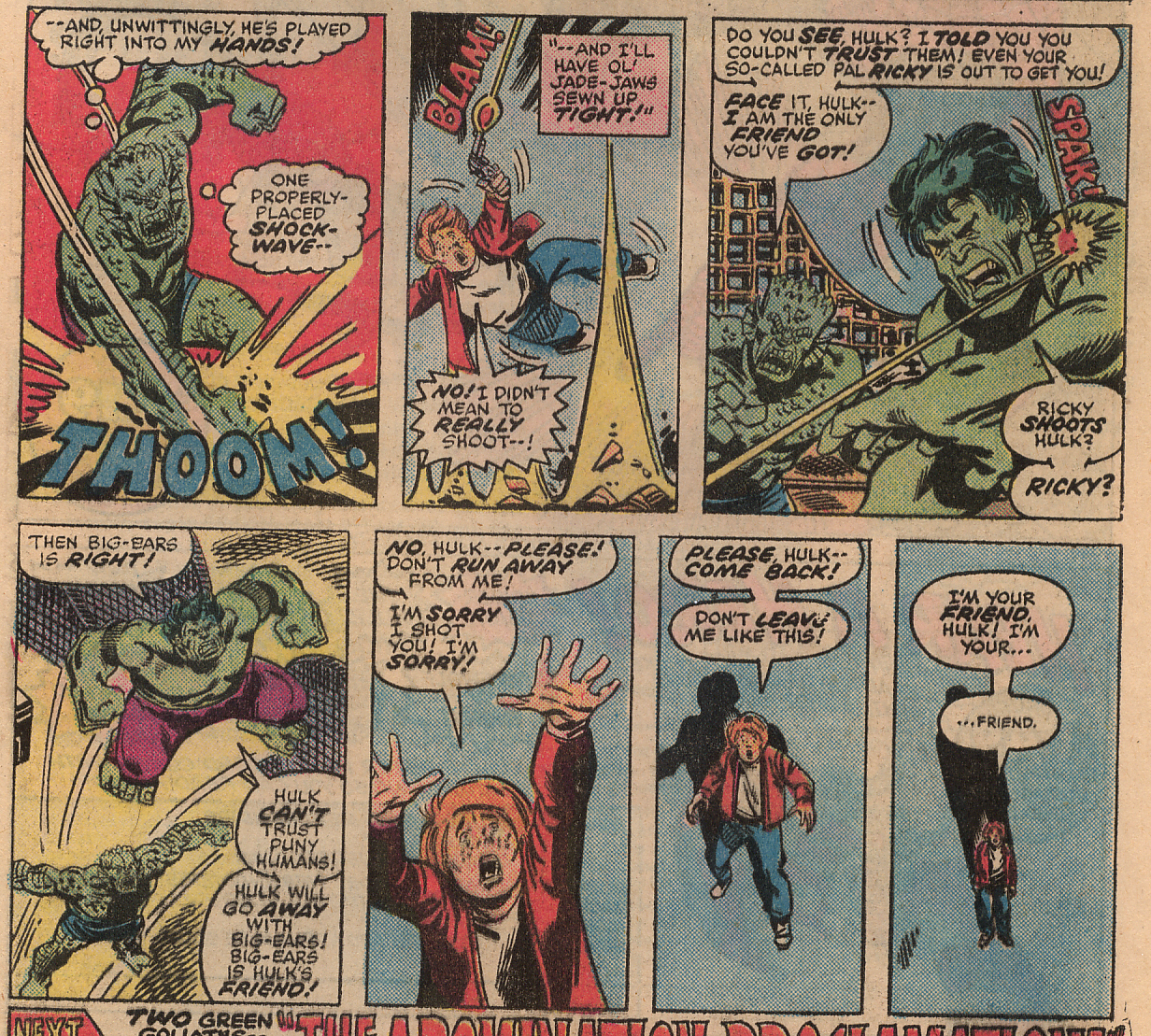
This sequence is from another Abomination issue, “Warfare in Wonderland.” In it, Hulk crosses paths with a young runaway named Ricky and thinks that at last he’s found a friend he can trust. And he has, except that asshat Abomination tricks him. My friend Tony Cruz, who lived two doors down from me, was the one who first showed me this comic, and I traded him a big rubber snake and a cap gun for it.


This panel takes me back to New Jersey, where we were visiting my Aunt Ann and Uncle Barry. My uncle listened patiently while I showed him just why the picture was so cool—the bad guy chained up the Hulk, see, but after the Hulk calmed down and turned back into Bruce Banner, he was small enough to climb out. I remember my uncle nodding and smiling, probably not following my breathless explanation or really caring, but definitely happy to spend time with his nephew and Godson. That’s how I like to remember my uncle—looking at a Hulk comic with me, instead of his slow, awful descent into Alzheimer’s.


This last sequence is from my favorite issue of all, “Triumph of the Toad.” It’s basically one long fight between Hulk and the Toad Men, led by their king, Torkon. Virtually every panel of this particular comic is etched in my memory; I remember reading and rereading it until it fell apart, replaced years and years later with a little help from a vendor at Comic-Con 2002. These four panels show the genius of Herb Trimpe’s visual storytelling with their varied yet fluid perspectives and angles, and they also embody the essence of the Hulk’s narrative—he’s chased, captured, abused in some way, and then escapes (usually into another crappy situation). I couldn’t get enough of this as a kid.

Or as an adult. Don’t get me wrong; I’ll definitely see Man of Steel, but it will be with the detachment that I bring to most of these comic book movies today. It’s a detachment based on the understanding that these versions of my comic book heroes are spectacles, lighter than the air under a bird or a plane, and not the stuff that childhoods are made of.


Sunday, December 2, 2012

Stuff I Saw

As I continue to work on the final revisions to That Hidden Road, I'm also thinking about how I'm going to assemble the different narrative pieces. Most of the book consists of long chapters that "cross cut" between my experiences on the road and various memories, but there are also shorter chapters that will pop up from time to time, like the "FAQ" writings that I've posted here.

And then there are the comics. My plan is to sprinkle throughout the book several different comics--a couple of multi-page stories as well as some one-pagers. One group of these one-pagers is a short series called "Stuff I Saw," which I intend to appear a little rough, as if from a sketchbook. I did all of the layout, lettering, and art myself. Most of the images are based on pictures I took, and observant readers may notice two of them that already appear on this blog. Anyway, here's a preview of four of the "Stuff I Saw" comics:

A little gruesome, maybe, but I had to pay some kind of tribute to all of the dead animals that I saw. By the way, coming across roadkill while biking is about a hundred times worse than while driving. First of all, there's the smell. Second, there's the fact that I was moving slowly, so I had plenty of time to take a good, long look. Third, there's not much you can do to avoid it. I tried to move around a dead possum in Missouri and almost got hit by a pickup truck.

I love roadside kitsch, and to my mind, there's none better than big statues of fake people. My two favorites are on the bottom row, both found in the tiny Illinois town of Metropolis. The best part was that "Big John" is about ten feet taller than Superman.

Comics are good at amplifying the quiet moments of life, and I tried to keep that in mind when I sketched these landscapes from various parts of the trip. I'm the least happy with the "Tennessee" panel; all of that dark stuff is supposed to be kudzu, which grows crazy-fast and has taken over thousands and thousands of acreage in the South.
Not every dog was my enemy. I made some canine friends along the way, too, and I wanted to get them into the book in a unique way. 

I'm planning to post more of the comics if there's any reader interest, so let me know!