"Count backward from one hundred."
I'm lying on a thin blanket and staring at three powerful-looking lights mounted to the ceiling. People in blue gowns and white masks move all around me; I know this not only because I can hear them but also because they keep popping up above me in my field of vision.
"One hundred..." I say.
My left arm lies against my side, an IV needle sticking out of a soft patch of innner elbow and trailing a long skinny tube that snakes somewhere behind and above me. I've got wires attached to various points on my chest and legs. My calves are wrapped in massage sleeves that are supposed to prevent blood clots. Something is beeping.
"Ninety-nine..."
The last time I was in a place like this, I was fourteen years old and about to have my appendix out.
"Ninety-eight..."
Now I'm having an orchiectomy, a word that I saw for the first time on Friday and that I've had to ask three different medical professionals how to pronounce.
"Ninety-seven..."
I've heard stories--probably bullshit--about anesthesia not working, about people being immobile yet able to feel every clamp, every retraction, every suction, every scissor snip, every scalpel slice. Again, probably bullshit, but when you're on the table, bullshit becomes a living, breathing thing.
"Ninety--"
And then it's over. I can see faces again--nurses', my doctor's--as they're moving my rolling bed back into place in the recovery room.
"How do you feel?" my doctor asks me.
She's a young woman who didn't in any way fit my expectations of what a urologist should look like when we had our first appointment last Friday. She didn't fit my girlfriend Shannon's expectations, either, when she met her for the first time that morning. I knew this from her narrowed eyes and the whispered, "We'll talk about this later..."
"Are you feeling okay?" my doctor asks again.
"Yeah," I say. "Big changes for Butch and Sundance."
"Who?" she asks.
I gesture vaguely at my crotch. "Butch Cassidy and the Sundance Kid. They just became the Lone Ranger."
Monday, October 28, 2013

Saturday, October 26, 2013
The Condition of My Condition
I’ve fallen lots of times on my bike, and it’s always the
same. My tire catches on the lip of a curb or slides on some loose gravel, and
there’s a sudden shift of weight and space. My body tightens and I imagine my
face registers something like shocked surprise. The world as I know it—a
carefully balanced ride from here to there—has radically and swiftly rearranged
itself, and I’m struggling to catch up.
But that only lasts a split second. The thing to do then is understand that you’re falling and nothing is going to change
that. Just ride out the fall and wait to land. Then pick yourself up.
When I heard from my doctor the afternoon of the sonogram
and he told me that I had a mass on my right testicle, a weird calm came over
me. I took a deep breath, heard the word Okay in my mind, and understood
that I had given in to the fall and was waiting to land. Got
it. A growth. So what do we do now?
My schedule immediately filled. Appointment with a
urologist. Biopsy of the growths that the CT scan turned up. Insertion of a
port for chemotherapy. Surgery on the morning of the 28th.
Okay.
The big news was that this was almost definitely not a
recurrence of my germ cell cancer from ten years ago; it was a new
one—testicular. I’ve never so much as won a fruit basket in a raffle, but
apparently I’d hit the cancer lottery twice.
But I’ll take that bad luck because it’s more than balanced
out—not even close, really—by my good luck at having the friends I have, and who
have leapt into action with a swiftness and focus that makes Seal Team Six look
about as efficient as the DMV.
Please Lie Still While I Crush Your Balls
When most people hear the word “sonogram,” they probably
conjure up pleasing images of a young man and woman holding hands and
expectantly watching a screen while a nurse gently slides the wand-like
apparatus over a smooth round belly.
Sadly, this isn’t exactly what happens in a testicular
ultrasound.
I’d been dreading this test from the moment my doctor said I
needed one to find out if this was in fact a recurrence or something new. I had
one ten years ago, and even though it came out negative, it was still pretty
much the worst part of that cancer experience. Would a normal person think
this? Probably not.
I went in early. The waiting room was empty except for a
woman sleeping under the television and an older couple who was having an
animated conversation in what I thought might be Hawaiian. I tried to focus on
the TV—some morning talk show was on—but I couldn’t follow the interview.
“Verasky?”
I turned to see an attractive woman with glasses who looked
like she was about seventeen.
“Versaci?” I tried.
“Oh, okay. Sorry. Come with me, please.”
She introduced herself as Hailey and told me that she was a
sonogram technician and would be doing the procedure today.
“That’s perfect,” I said.
As we walked down the hall, I asked, “Have you done a lot of
these?”
“You’ll be my second.”
In the small, dimly-lit room, she walked me over to a bed
and pulled a curtain around. I felt like I had to come clean.
“Okay,” I said. “A couple of things. First, I’m a little tender
down there right now. And second, I’m a huge baby when it comes to my balls.”
She just looked at me.
“I mean, I’m definitely going to be your worst patient of
the day.”
She laughed nervously. “I’m sure you’ll be fine.”
“I’m sure I won’t,” I said. “But listen. If I pass out, I
want you to just go ahead and do the procedure while I’m out.”
She stared at me. “Can you please take off everything below
your waist and sit on the bed? I’ll be right back.”
I stripped and waited. I heard footsteps before the curtain
pulled back and there was another woman standing there. Also attractive.
“I’m Natalie, and I’ll be doing your sonogram today.”
“Did I freak out Hailey?”
“A little bit, yeah.”
I gave Natalie the same spiel, all in the interests of full
disclosure.
“Well, you just relax, and we’ll go slow.”
“Okay, but I want to apologize in advance for the
undignified behavior that you’re about to witness.”
She snorted, then arranged me on the bed, a towel over my
thighs just below my scrotum, and a towel over my penis just above my scrotum.
She spread some gel on the edge of the sonogram wand, which looked like a
little vacuum cleaner attachment.
“This might be a little cold,” she said, and moved the wand
down to my balls.
At the moment I sensed contact, my entire body tightened up
and I clutched the top towel in my hands. The force pressing down on the most
sensitive part of my body was more than I could bear. This was worse than I
remembered, worse than I could have imagined.
“I haven’t touched you yet,” Natalie said.
It didn’t get much better. She told me to just breathe
normally, and I thought I did, but then she warned me not to hyperventilate.
She also mentioned at least twice that it was taking a little longer because
she was going so slow.
When it was over, I said, “You’ve been doing this for a
while.”
“About thirteen years.”
“So, I know a radiologist has to read this, but can you tell
me what you think?”
She looked at me. “I really can’t.”
“I can’t help thinking that if I’d been a better patient,
you’d tell me something.”
She smiled. “Go ahead and get dressed.”
Just before I left, I said to her, “You should be grateful.
Now you’ve got a ‘this one guy.’”
“What do you mean?”
“Well, the next time someone gets anxious on the bed there,
you can just say, ‘Listen, I had this one guy…’”
She laughed. “You take care, now.”
The News
So, the tests.
My doctor sent me for another blood test that day, on
October 11th. Just to confirm the first results. Of course, they
did.
Then a CT scan on the 17th. Chest, abdomen,
pelvis. I hadn’t had one in a while, but it’s amazing how fresh the details
stay. Choking down almost a full liter of barium in the hour before the scan. I
did have my choice of flavors—mint, bubblegum, or orange—but there’s no hiding
the chalky texture. For the record, I picked orange, but it really should have
been called “vaguely orangish.”
Another part of the CT is the iodine dye that they send
through an IV. The technician, a young guy named Eric with a bone-grinding
handshake, put the line in my arm and fastened it with what later felt—when he
pulled it off—like duct tape. He began to tell me what the iodine would feel
like, but I stopped him and said that I’d been here before.
“Okay,” he says. “I’m starting it now.”
A puddle of heat spreads across the back of my throat. I
swallow reflexively, but it’s not going to go away. In fact, it grows. I can
feel the warmth leak slowly down the length of my spine and pool in my crotch.
It’s not pleasant. It’s made even less pleasant by the fact that those two big
containers of barium are now pushing urgently against my sphincter.
“We’re almost done,” he says, as if sensing my discomfort.
And then we were.
The results came in the following Monday. I was sitting in
my office, ready to bike home but waiting for my doctor to call with the
results. Finally, the phone rang.
“How are you?” I asked him.
“I’m fine,” he said. “I wish I could say the same for you.”
He told me that I had “multiple growths” in roughly the same
vicinity as last time. He said that he’d never heard of a ten-year recurrence
of germ cell cancer. We made an appointment for the next day so that we could
go over everything in more detail. I knew it was coming, but clearly a part of
me still believed that the two blood tests had all been a giant mistake. And
then, as if I needed another reminder that we’re all prisoners in our bodies
and slaves to what they might do to us, I got cold, my hands—and, presumably,
the rest of me—turned white, my head started to hum, and I felt like I was going
to throw up.
Guy Walks into a Doctor's Office...
…and gets told that he has cancer again after ten years.
Sorry, pretty shitty punchline. But it’s the one that I’ve been
dealing with since Friday, October 11.
When I finished my chemotherapy for germ cell cancer back in
September of 2003, I’ve been going back for regular tests make sure I was still
cancer-free. For the first year or two, these tests were intense—blood tests
and chest, abdominal, and pelvic CT scans every three months. For a year after
that, they dropped to every six months, and then annually. After five years, no
more CTs; just blood tests.
My anxieties experienced a similar decline. I thought about
my cancer constantly for the first few years, then occasionally, then pretty
much not at all.
So this year—my ten year anniversary of being cancer-free—I
almost didn’t make an appointment. I’d started to get the feeling that my
doctor didn’t need or want to see me anymore. In fact, on my nine-year visit,
he turned me over to a physician’s assistant. I figured I was in the clear.
The nurse had just taken my temperature and blood pressure,
and I was waiting in the little room for someone—my doctor? another PA?—to come
in. As I waited, I Googled “blood pressure charts” because the numbers the
nurse recited to me seemed a little high. I was worried that I might have
hypertension.
I’m trying to recreate that moment in my head. I’m hunched
over in the stiff-backed chair, one hand holding my phone while the other one
scrolls through Google hits and waits for them to load. While they do, I stare
at my black Vans, which are starting to fade out to gray in the toes a little.
One shoelace looks a little loose.
I want to savor this moment because it’s the last moment of
peace that I remember. Funny thing is, it didn’t seem peaceful at the time (Do
I have high blood pressure? Do I need to get a new pair of shoes?). I
thought these were real worries. A few seconds later, they became laughable.
My doctor walked in. He was looking at an open folder in his
hands.
“Your tumor markers are up,” he said.
Ba-da-BUM
Thanks, folks, you’ve been great. I’ll be here all week.
Sunday, September 1, 2013
The Evolution of a Page
Time has really gotten away from me. I can’t believe that my
last entry was way back in June. Between now and then I’ve been to Chicago
twice, taken a trip up the California coast to look at colleges with my high
school senior son, and waded through armies of costumed fans at Comic-Con.
Oh, and I finished my book.
To recap, the book is called That Hidden Road, and it’s
about my solo cross-country bicycle ride, which I made in the summer of 2010.
It’s also about those parts of my life that made me think I needed to go on a
long, long ride by myself.
I knew from the start that I wanted comics in the book, and
I knew that I wanted to draw them myself. Problem was, my drawing skills were a
little rusty and I’ve never made comics before.
As I drafted and revised the manuscript, I played around
with some ideas for comics and eventually came up with three main types. Backin early December, I posted a few pages from one of these, which I called the “StuffI Saw” pages. Pretty simple idea—one page of six panels each in a more or less “realistic,”
sketchbook-y style. The second group of comics I called the “Voices from the
Road” pages. These would also be single-page comics, but have only four panels.
The style would be a little more cartoonlike and focus on some people I met
along the way who made brief but memorable impressions on me. I finished these over
the summer. Finally, the third group of comics would be more sustained
narrative; there’s a brief two-page story in the prologue called “Pre-Ride
Jitters,” and there’s a longer (eight pages) story in the middle of the book
called “Welcome to Springview Farm.”
This story covers the few days that I spent on a farm in
Missouri—a farm that belongs to Jan and Bill Montgomery, who happen to be the mom and stepdad of my best friend. I didn’t want to
fold that story into one of the other chapters; instead, I wanted it to stand
on its own even though I couldn’t—at least early on in the writing—say why.
Now, with the benefit of hindsight, I decided to write a
blog post that went into some detail about how part of this story came
together, and I thought that the easiest way to do that would be to document
the evolution of a single page from “Welcome to Springview Farm.” The page in
question is the third of the story, and it covers part of the tour that Jan
gave me of the farm and house.
In writing this and assembling the materials I used, I found
it very helpful to me as a writer to step back and examine my creative process a
little more closely. As I said before, despite my lifelong love of comics and
the fact that I teach and write about them, I’ve never—until this book—tried to
make comics myself, at least not in any organized way. So I thought I’d give a
shout-out to several helpful sources along the way, including Scott McCloud’s Making
Comics, Barrington Barber’s How to Draw Everything, Bruce Blitz’s The
Big Book of Cartooning, the many Facebook postings by Ed Piskor of his work
on Hip Hop Family Tree, several Youtube videos by Alison Bechdel about the
construction of Fun Home, my friend and comics goddess Mary Fleener, and conversations with students much more
talented than I am in this regard.
It’s hard to pinpoint exactly how the story came into being.
I think I got the idea within the first hour or two I spent with Jan and Bill. They're incredible people who are also pretty wacky, and as Jan showed me around and told me stories, I realized
that the written word alone couldn’t do justice to this bizarre and comic
experience. I was going to have to tell the story through comics.
Coming to this realization was the easy part. In writing
this book, I’ve found that the most challenging part of memoir comes in trying
to shape and narrativize your experience. Fact is, there’s a lot of dead time
in our lives, but story demands at least some kind of structure. To
get there, we need to arrange, amplify, and discard the pieces of our
experience and hope to hell that in doing so we arrive at a
meaningful truth. With comics, one’s experience becomes even more fragmented—literally,
by individual panels. Plus, the canvas is much smaller, and the words that make
it in must be pared down yet still work effectively in conjunction with the
corresponding image.
Because I’m a textual kind of guy, I started with a script, though
that’s a little generous of a description. It was really more of a sketch with
words—lines of dialogue loosely coupled with some ideas for images. The draft
was long and rambling, and like most drafts, I ended up axing close to half of
it. The section of the script that covers this particular page reads as
follows:
Springview Farm is filled
with strange and wonderful creatures…
Underfoot, the invisible
barn cat
Goosey and Goofy (two
llamas)
??? (pygmy goat)
A Watusi bull (image of me
taking its picture while it’s trying to mount cow)
Jan: “Oh for the love
of Mike, don’t show them that.”
Me: “Why not? It’s nature!”
Jan: “It’s Eskimo!”
Me: “Huh?”
Jan. “I don’t like the word ‘nasty,’ so I say
‘Eskimo’ instead.”
Inside the house is just
as interesting…
Fisherman lightswitch
Stuffed owl that watched
me.
Jan’s closets
The Fairy Closet
The Shower Closet
The Memories Closet
Closeup of Chuck and Dewey poster
Jan’s dolls
The events depicted on this particular page took place in
late June of 2010, and I didn’t really start drafting this script until almost
a year later (fortunately, I had my photographs and journal from the trip).
Like most of the drafting I do, I didn’t pause too much to double-check
details. For example, I couldn’t remember the name of Jan’s pygmy goat, so I
let that go. I also didn’t know what kind of bull they had (just that it looked
really strange), so I let that go and filled in “Watusi” later, after calling
Jan. At that point, I knew that the goat wasn’t going to make it on the page,
so I didn’t bother to find out its name (sorry, pal). As I wrote, I also knew
that part of my brain was thinking in terms of comics. I had an idea about what
to do with that bull, and I see in the writing that I had an idea for both the
image and the word balloons.
The next step was to sketch the panel breakdowns. I saw that there was way too much material here to fit coherently, so I had to
narrow it down, to start shaping the experience into narrative. I wanted to
make this part of the story unfold as a kind of a “walking tour,” but the big
question was, What to keep? Two parts of this section jumped out at me:
the Watusi bull and the dolls. For the moment, I put the dolls aside. I knew that
I wanted the panel with the bull to be big—the width of the page. In part, that
was out of necessity; there was too much image and dialogue to cram into a
smaller panel. I figured the rest of the page would break down in a steady
rhythm of three equal-sized panels per row. I laid out the panels as textboxes in
Word, and they came out like this:

To accommodate this layout, I had to start this page with
the bull scene, so I moved the the material in the script that comes before—the
cat and the llamas—onto the previous page. That seemed to work well in terms of
rhythm, where my introduction to the various animals would climax with the
bull, and he’d be at the top his own page in a panel befitting his size and, uh, horniness.
Now, back to those dolls. Sifting through photos, journal
entries, and memories, I recognized that the real “punch” of my tour of the
farm was Jan’s collection of creepy dolls. Anyone who knows me well knows that
I’m terrified of dolls; it all dates back to an episode of Night Gallery that you can read about here.
Because I wanted the “weight” of the page to come down on
these dolls, I reserved the bottom row for them. With three panels left in the
middle, I had to pick and choose from the remaining details. I knew I needed one
of Jan’s closets in there (she has an interesting array of closets in the
house), and I went with the converted shower closet, because it’s just so Jan.
I also liked the light switch cover where the switch became the naked
fisherman’s penis (again, very Jan). It seemed like it would be an interesting
visual to pull off, so to speak. I also liked that it comes right after the bull trying to hump the cow. For the third image, I decided on the owl. I
originally picked it because my plan was to make it the third image in the row
so that two figures—a naked man and a bird—would “frame” the closet. Only later
did I come up with a better use and reason for that owl. I did a very rough
sketch of how I saw the panels:

The drawings are intentionally primitive; my purpose here was
simply to get a very rough sense of what’s going to be on the page.
Now I had to decide on text and put the words into boxes and
balloons. By visualizing the “containers” for the text, I’d get a better sense of
how much space I had to work with and how to compose the panels. By sharpening
the text into the exact language, I’d get a better sense of what exactly to
draw. At this stage, I started to think more about that owl and what I was
trying to do with the story as a whole. I said earlier that I didn’t want to
fold my time at Springview Farm into a prose chapter and I wasn’t sure why. In
actively mapping out the story, though, it came to me that it was about finding
a substitute family on the road. In fact, “Welcome to Springview Farm” is split
into two parts, and they bookend the very central chapter of That Hidden
Road, when I drive to Chicago to see my real family. Thus, “Springview Farm”
serves as a kind of counterpoint to that experience.
Anyway, back to that owl. The very end of the story is the day
I leave the farm. It was raining when I left, and I wound up spending that night in a tiny Missouri town named Houston. I called Jan and Bill to let them know I made it to my next
stop in one piece, and Jan confessed to me that they followed me for a few miles in their
truck, just to make sure I was okay. As I was writing this part of the script,
I wanted to convey that feeling of being watched over, and I remembered the
owl, stuffed and staring at me in my room at the farm. Now, the thing
about Jan is that she names everything, but I couldn’t remember if the owl had
a name. Indulging a little bit in the “creative” part of “creative nonfiction,”
I decided to name it “Mama Owl” and attribute it to Jan. I mention Mama Owl again on the last page of the story. At this point, I knew that I had to
move Mama Owl to the middle of the page, which is the most important space in a
comic. The panel breakdown with text inserted looked like this:

It’s worth noting here that once I typed the text on the
page, more revision was needed. I had to shorten some lines, move some of the
dialogue around, and play around with font sizes. The point here—and one that I
stress to my writing students—is that revision is ongoing and the
writing process is recursive; you take two steps forward and one step back
almost constantly.
Once I was happy with the page, I printed it up, taped it to
my drawing board with artist’s tape and the help of my t-square, boxed and ballooned
all the text, and got ready to sketch my pencils. To help with this, I had two
main tools at my disposal. First were the many, many photos I took at the farm.
Here are some of the ones I used:


The second tool was my sketchbook. I’ve found that it’s been
indispensible in testing out different visual ideas and to practice drawing
different things. Here are a few of the sketches I made while penciling this
particular page:


In the original sketch, I had Bill standing there, too, but the
panel was getting a little crowded. Plus, the dialogue focused more on a
back-and-forth between me and Jan, so I cut Bill out. But not to worry; Bill is
very present in the rest of the story. And he knows I love him.
The next stage was actually biting the bullet and getting
the pencils in the panels. I decided that I wanted to have some fun with the
style, so I made the top panel more cartoony and the bottom six panels more realistic.
I wanted to give those six panels more of a documentary feel to them—like a camera’s
eye roving around the farm—so it made a certain sense to me that the art should
reflect that. After the better part of a day filled with plenty of erasures, here’s what the page looked like with the text, boxes &
balloons, and pencils:

The final stage was the inking. This is where pencil lines
get sharpened and more depth is added through line weight and shading. I’m not
yet completely confident with this very difficult skill, so I turned over
inking duties to my talented buddy John. He threw my pencils on his lightbox,
inked it up (without the text), and scanned it for me. I then opened it in
Photoshop, retyped the text (and, yes, revised it some more), and performed some minor
tweaks to the images. Here, then, is the final product:

All told, there are over thirty pages of comics in the
manuscript of That Hidden Road, and I’ve developed a newfound respect
for the work that comic book artists do. I knew intellectually that it was
difficult work, but until I tried it myself, I had no idea how
difficult.
But it’s also incredibly rewarding, like any kind of
creative activity that allows you to “disappear” inside of the work. Entire
afternoons would evaporate as I’d get my drawing supplies out, set my iTunes to
“shuffle,” and get busy turning my life into story.
Well, if you've made it this far, I thank you. I'd love any feedback on what I have here or on your own process of writing, drawing, or both.
Saturday, June 8, 2013
"Man of Steel"? I'll Take "Hulk Smash!"

In a week’s time, another comic-book-turned-movie will hit
screens and create a storm of midnight showings, long lines, and box office
tallies that—whether they come in above or below expectations—will still drop
faster than a speeding bullet over the ensuing weekends.
I’m talking, of course, about Man of Steel, the
latest reboot of the quintessential comic book character and the one that most
people see as the face of the entire medium.
I have to admit that I was never much of a Superman fan. In
most writers’ hands, he’s uninteresting, a little too straight-laced and
perfect. Yes, there’s Kryptonite, but that’s a plot device, and not a very
artful one at that. It has nothing to do with human flaws or frailty—the kinds
of things that make superheroes recognizable to their audience. For my money,
the best Superman stories have tried to complicate him and get under his
impregnable exterior. Stories by Alan Moore (“For the Man Who Has Everything”
and Whatever Happened to the Man of Tomorrow), Jeph Loeb and Tim Sale (A
Superman for All Seasons), and Grant Morrison (All Star Superman and
his run on JLA) are like gold nuggets. And they’re just as rare.
Speaking of gold, there’s plenty to be mined in this new
version of Superman. In the last several weeks he’s been everywhere, providing
more power than a speeding locomotive to marketing campaigns for the Army, for
Dodge Ram trucks, and for Carl’s Jr. cheeseburgers, to name a few. This is
Superman as brand, not character, and everyone is trying to cash
in; Man of Steel has reached new heights (or lows, depending on yourpoint of view) in product placement spots.
But I’m not here to criticize the moneymaking practices of
Hollywood. The Superman juggernaut, coupled with the fact that I’m now off for
the summer, has made me nostalgic. So I headed to the long boxes in my spare
room’s closet. That’s where I keep the majority of my comics collection. The
word “collection” implies value, and there’s plenty of that, but not in monetary
terms. It’s more about memories. And by this measure, the value of one title
exceeds all others.
The Incredible Hulk.
I loved monsters at the time, and part of my fascination
with the Hulk was that it wasn’t really clear whether he was a monster or a hero.
A little of both, really. What was more clear was that he was misunderstood and
nobody would leave him alone. I’d read these comics and find myself feeling
sorry for him the same way I felt sorry for some other monsters I’d seen on
television in movies like Bride of Frankenstein and Creature from the
Black Lagoon.
I liked that the Hulk’s enemies were monsters, too. No other superhero had as grotesque a
rogues’ gallery; notable members included the Leader, the Gremlin, the
Abomination, and—my personal favorites—the Toad Men. I may have liked these
guys best because there was a big field behind our townhouse, and I was always
catching the toads that fell into our window wells.
What I understood viscerally as a kid and more
intellectually now is the power of visual narrative. I’d devour these comics
without paying much attention to the writers or artists, but now I know that a
big part of the Hulk’s spell over me was due to talented pencillers like Sal
Buscema and the great Herb Trimpe.
Some of their images are indelibly printed on my brain. The
original Hulk comics I owned as a kid are long gone, thrown out by my mom one
day when I was at school. In recent years, though, I’ve replaced some of these
with help from online dealers like Mile High Comics and MyComicShop.com, from
the back issues sections of nearly every comic book store I’ve been in, and
from the myriad booths at Comic-Con every year. Whenever I find one, its cover
or some drawing inside appears to me like a vision from a dream that I woke from hours earlier. There’s a flash of recognition, of remembering
something vivid, and my waking life pauses. For me, it’s not just the image that stops me, but all of those memories that the image comes wrapped in.
Here are a few that stand out:
Here are a few that stand out:

One look at this panel takes me back to a motel room in
Clarion, Pennsylvania, where we’d stay every summer on our way to New York. My
dad and brother were watching a baseball game on TV, and I was pouring over The
Incredible Hulk #202, which I’d stashed in my suitcase for the trip. After Hulk
smashes the giant—who turns out to be a giant robot—he’s blasted in the chest
with a laser wielded by a one-eyed insect man named Psyklop. To be continued
next issue. The problem was, I didn’t have the next issue. I would be well into
my thirties by the time I finally tracked that down #203 to find out what
happened. (Spoiler alert: Hulk smashes Psyklop and his minions, too).

This one is from The Incredible Hulk #171, “The Hulk at
Bay.” In the 70s, Marvel released some comic book and record combinations, and
I had this one. My brother and I had a little portable record player, and I
remember listening and reading along as I waited the whole time for this full
page spread, which terrified me as a kid. Two monsters—the Abomination and the
Rhino—aiming the full force of their fabulous fury (how’s that for
alliteration, Smilin’ Stan Lee?) right at me.
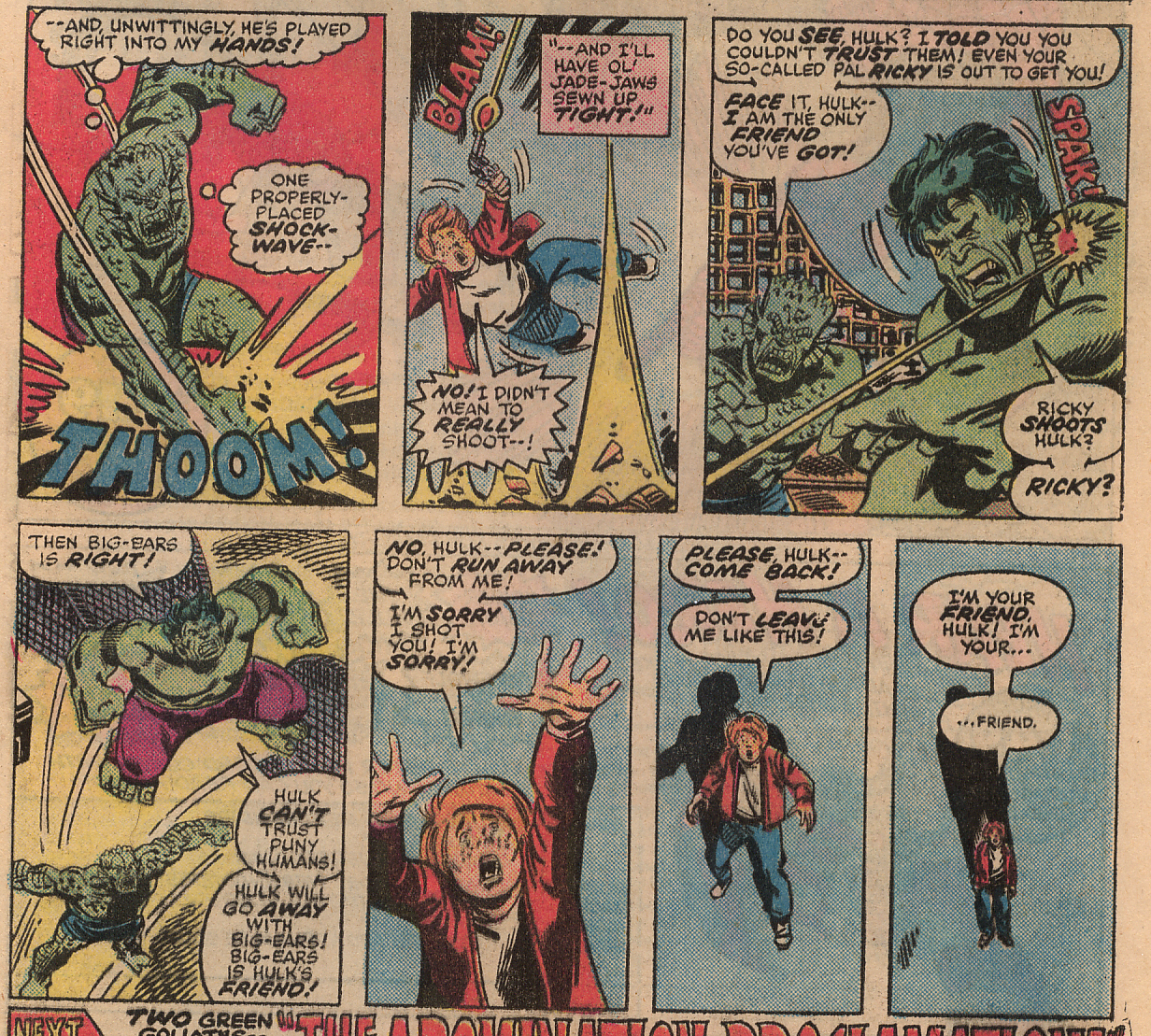
This sequence is from another Abomination issue, “Warfare in
Wonderland.” In it, Hulk crosses paths with a young runaway named Ricky and
thinks that at last he’s found a friend he can trust. And he has, except that
asshat Abomination tricks him. My friend Tony Cruz, who lived two doors down
from me, was the one who first showed me this comic, and I traded him a big
rubber snake and a cap gun for it.

This panel takes me back to New Jersey, where we were
visiting my Aunt Ann and Uncle Barry. My uncle listened patiently while I
showed him just why the picture was so cool—the bad guy chained up the Hulk,
see, but after the Hulk calmed down and turned back into Bruce Banner, he was
small enough to climb out. I remember my uncle nodding and smiling, probably
not following my breathless explanation or really caring, but definitely happy
to spend time with his nephew and Godson. That’s how I like to remember my
uncle—looking at a Hulk comic with me, instead of his slow, awful descent into
Alzheimer’s.

This last sequence is from my favorite issue of all,
“Triumph of the Toad.” It’s basically one long fight between Hulk and the Toad
Men, led by their king, Torkon. Virtually every panel of this particular comic
is etched in my memory; I remember reading and rereading it until it fell
apart, replaced years and years later with a little help from a vendor at
Comic-Con 2002. These four panels show the genius of Herb Trimpe’s visual
storytelling with their varied yet fluid perspectives and angles, and they also
embody the essence of the Hulk’s narrative—he’s chased, captured, abused in
some way, and then escapes (usually into another crappy situation). I couldn’t
get enough of this as a kid.
Or as an adult. Don’t get me wrong; I’ll definitely see Man
of Steel, but it will be with the detachment that I bring to most of these
comic book movies today. It’s a detachment based on the understanding that these
versions of my comic book heroes are spectacles, lighter than the air under a
bird or a plane, and not the stuff that childhoods are made of.
Subscribe to:
Posts (Atom)